Posts tagged with "Uncategorised"

Digital literacy, passion and changing educational paradigms

On Sunday, I finally found the time to listen to the recording of guest Will Richardson, author of Blogs, Wikis, Podcasts, and Other Powerful Web Tools for Classrooms, from Wednesday’s #PLENK2010 live Elluminate session. In this session, Will gave a short presentation Using PLE’s Successfully and a couple of things came up.

First was a summary of the recommendations on 21st Century* *Literacies from the US National Council of Teachers of English (NCTE) [1]:

  • Develop proficiency with the tools of technology
  • Build relationships with others to pose and solve problems collaboratively and cross-culturally
  • Design and share information for global communities to use for a variety of purposes
  • Manage, analyze and synthesize multiple streams of simultaneous information
  • Create, critique, analyze, and evaluate multi-media texts
  • Attend to the ethical responsibilities required by these complex environments.

This is a pretty sophisticated set of competences that I would struggle to demonstrate. It’s even more challenging, when you consider that these are the aspirations of a professional body for teachers of *high-school age* children! Do we even do this for our undergraduate and postgraduate students? Would I and my colleagues be competent to teach these high-level **digital literacies **[2] to them?

The second theme was a set of principles for creating and successfully using a PLE: - Pursue your passion. - Read widely. - Filter. - Share. - Add value. - Be personal … sometimes. - Manage/balance.

I can see how these principles might apply to my own PLE, which for me is centred around this and the Learning Lab blog. But it’s not quite so obvious how it might apply to our students. Too often, we try to get them to engage with the tools of a PLE by telling them that it’s *good* for them, and we then try to get them to engage with a topic related to a course we are teaching or a topic within a course of *our* choosing, and we try to force them to engage by assigning credit. Would they engage more if they were able to *pursue their passion* while we supported their learning as mentors rather than assessors?

In the discussion, will mentioned the Royal Society for the encouragement of Arts, Manufactures and Commerce (RSA) animation Changing Education Paradigms which is based on a speech given to the RSA by Sir Ken Robinson [3]. An idea, and its presentation, well worth sharing.

**References**

1. *Definition of 21st Century Literacies*, National Council of Teachers of English (NCTE), February 15, 2008. URL: http://www.ncte.org/governance/literacies. 2. Barbara R. Jones-Kavalier and Suzanne L. Flannigan, “Connecting the Digital Dots: Literacy of the 21st Century”, *Educause Quarterly*, Volume 29, Number 2, 2006. URL: http://bit.ly/dabAsD. 3. Sir Ken Robinson, *Changing Paradigms*, RSA Edge Lecture, 16 June 2008. URL: http://bit.ly/bMz8FM. video: http://youtu.be/mCbdS4hSa0s.
Podcast of the Week #7: Pythagoras' Trousers

The title of this occasional series is a bit of a joke as it’s been several weeks since my last Podcast of the Week post. Nonetheless, it’s worth breaking my silence this week because this month‘s podcast of the week has local and professional interest. I’m a committee member of the Wales South West Network of the Institution of Engineering Technology (IET). Serving in the Young Professionals Network is ‘young’ Rhys Phillips who broadcasts a Science, Technology, Engineering and Mathematics (STEM) podcast called Pythagoras’ Trousers on Sunday mornings on Radio Cardiff (7.30-8.00 am). Now, that’s not in receiver range here in Swansea, but it wouldn’t be a modern, thrusting radio show if it didn’t also provide a web site for web broadcasts and a podcast.

Although there have been only 6 episodes so far (they’re all still available on iTunes), Rhys has managed to interview some quite high profile people including broadcaster and writer Simon Singh and Project Leader of the Large Hadron Collider Lyn Evans of CERN.  Plus he’s flying the flag for STEM and the IET in Wales, so all power to his elbow.

Bad Times - Good Times

The college newsagent had sold out of The Guardian, so I bought a copy of the latest Times Higher. There were two main features of interest. The first, mostly bad news for the UK academy, were the reports of the likely impact of the Browne review that was published this week
“Lord of the market: let competition and choice drive quality.” The future looks dark indeed, with strong hints (see Leader: A gamble on the Market) of a 70% reduction in teaching budgets and the decimation of funding for non Science, Technology Engineering and Mathematics (STEM) subjects.

And though Browne’s review is careful to talk only about funding in England, Wales is sure to follow.

Apart from one bright point, hidden away in the Review in Summary

All new academics with teaching responsibilities would undertake a teacher training qualification accredited by the Higher Education Academy.

it’s a tale to take the shine off any academic’s day!

So it was with some relief that the other major feature was a two-article feature on Social Media: Don’t Be Afraid to Share and Face Values. The former features quotes from Martin Hall, Martin Weller, Alan Cann and Jim Groom. Some of whom should be familiar to my fellow #PLENK2010 lab rats. Cann, who’s experiments with student PLEs and FriendFeed inspired me to create a PLENK2010 group (see Tuesday’s post), has some things to say that are apposite to this week’s topic of assessment in PLE:

I don’t want to be building some ghetto destination that students have to go to get marks. If we want our students to build social networks that they will use, we need to use public destinations and online resources that people already have confidence in.

The second article is concerned with the face that people project on the social network Facebook. Apparently, though not as inhibited as people my age and older, young people aren’t as reckless with giving away their personal lives as the media would have us believe.

Life under the microscope

Today’s live #PLENK2010 session was ostensibly about assessment in a Personal Learning Environment but it seemed to be more about how PLENK2010 (the research project) could assess whether the participants (us) could assess their own learning or indeed whether or not it was possible to assess what learning actually happens or could happen in a Massive Open Online Course. In other words, we PLENKers are lab rats running the maze of a completely unstructured learning experience so that the people in white coats can observe us and form theories about how lab rats learn so that they might build the personal learning environment of the future.

(And wasn’t an early lesson of the first two weeks that a platform built by a third-party is not a personal learning environment and is therefore by definition a VLE/LMS and must by the philosophy of this course be a bad thing?)

Maybe I’ve taken the wrong message home with me … but I feel like I’m somehow under the microscope, and I’m not sure that I am comfortable with that role.

One thing I am sure of is that if I set up one of my courses like PLENK2010, my students would have all bailed out by now and I’d be having to justify my teaching methods in front of the Dean.

I might be enjoying myself immensely, despite falling badly behind on my coursework, but I think my students might be more goal oriented, and I’m not sure yet what I can transfer to my own teaching.

PLENK2010 - It's a Marathon not a Sprint!

Losing Contact!

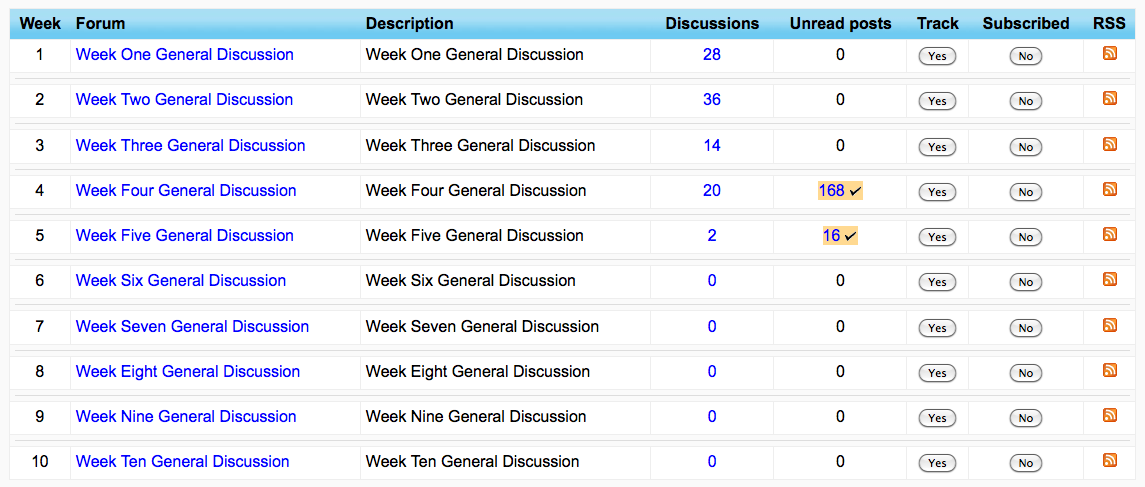
The faciltators said we couldn’t possibly read everything, but I feel like I’ve not read anything from Weeks 4 and 5. As you can see there’s a huge amount of discussion going on in the Week 4 forum and it’s already building up in Week 5 which has just started. And that’s not even counting the twitter feed and The Daily. I feel like a marathon runner who went too fast for the first 3rd and is not going to make the 13 mile marker.

Part of the problem is the encroachment of my real job … but still, I need some encouragement here.

No PLENK this week

Apart from multitasking through the two Elluminate sessions this week and “curating” the course materials in my Week 4 Pearltree, I’ve hardly participated in #PLENK2010 this week. It’s not because of the week four effect discussed in Dave Comier’s blog posting Cluster and Focus -> Surviving week 4 of a MOOC, neither is it the “painful and confusing” nature of this week’s topic PLE/PLN and learning theories. Rather its the imposition of real life. This week is the first week of my University’s new academic year and there’s been just too much to do.

Unfortunately, the materials continue to pile up: 88 unread posts in the 16 Week 4 discussions, countless missed tweets and 6 day’s of “The Daily”.

“Cluster and focus” says Dave … easy for you to say, say I.

Week 3: The eXtended Web

This week’s PLENK2010 topic is an exploration of what Steve Wheeler has called Web 3.0, Stephen Downes has christened Web X, George Siemens calls xWeb and Rita Kop calls the eXtended Web. I prefer Sir Tim Berners-Lee’s name of the Data Web introduced in this TED talk and discussed here (Pivot My Data) back in March.

Out of interest, I present the Wordles of, clockwise from top left, Berners-Lee’s TED talk, Siemens’ xWeb, Kop’s eXtended web and Wheeler’s Web 3.0 presentation.

Tim Berners-Lee on the Next Web (TED, 2009)

xWeb (Siemens 2010)

Web 3.0: The way forward? (Wheeler 2010)

The eXtended Web and the Personal Learning Environment (Kop, 2010)

I’m not sure you can make any serious points about such visualizations but it is sort of interesting. It is clear that Sir Tim’s message was chiefly concerned with data and to some extent people. George’s discussion concentrates on the web, data and his new buzz-word xWeb as well as people. Rita’s take is clearly more about learning and accessibility and Steve’s slides mention Web an awful lot.

But in reality, my main reason for blogging these is that they look nice.

A day in the PLENK

At the end of the Beatles’ seminal Sergeant Pepper album is the track “A Day in the Life.” Those who’ve heard it will know that right at the end of the track, and therefore the album, is the climax in which an orchestra works itself up into a frenzy of noise before a single piano chord brings the whole thing to an end.

PLENK2010 has been like being in that orchestra this week. An awful lot of sound and fury (signifying nothing?). I’m prepared to believe that learning could be an emergent property of a MOOC, but I for one am glad to hear the closing chord.

We’re promised fun with the neXT/eXtended web next week. Let’s hope it is.

Missing the ocean for the seashells

Swansea seashore

Earlier today, over in PLENK2010, Eduardo Peirano started a discussion Personal Learning and the […] Seven Principles of Good Practice in which he linked to a paper by Chickering and Gamson (1987) with the suggestion that the seven principles might be used to evaluate Personal Learning and the whole MOOC experiment.

What are the principles?

Good practice in undergraduate education:
1. encourages contact between students and faculty, 2. develops reciprocity and cooperation among students, 3. encourages active learning, 4. gives prompt feedback, 5. emphasizes time on task, 6. communicates high expectations, and 7. respects diverse talents and ways of learning

On reading these principles and the short explanation, I was struck not by the idea of using the seven principles to evaluate some modern practice, per se, rather, by the realization that the principles are a long way from being even partially embedded in higher education at all!

To quote my response:

I am sad to say that it leaves me somewhat depressed as it’s my observation that we are still failing to deliver on this good practice nearly twenty years later (and I count myself amongst the guilty). A big problem, it seems to me, is that sound pedagogy is a very poor relation to the need to publish in HE, and though I’m late career and feel that I’m not in that rat race anymore, I still have so much to learn about how to teach.

I’m starting to feel that I should stop worrying about management systems and the personal environments and learn some fundamentals about how to encourage the Learning. I feel like a kid on a beach entranced by the pretty shells and oblivious to the ocean.

In my own case, I think that I should be worrying less about the technology of Personal Learning Environments, Networks and Knowledge technology and learning more about the educational theory that lies behind it.

Reference

Arthur W. Chickering and Zelda F. Gamson, Seven Principles for Good Practice in Undergraduate Education, American Association for Higher Education Bulletin, March 1987. Republished with permission by the Faculty Development Committee of the University of Hawaii, Honolulu.

Response to Martin Weller's Paper

I’ve just finished reading Martin Weller’s paper The Decentralition Dillema in Education IT (one of the PLENK2010 week 2 readings) and I thought I’d use audioBoo.fm to say a few words about what we have at Swansea.

Here’s the recording:
http://boos.audioboo.fm/swf/fullsize_player.swf

Martin will be a guest presenter at the Wednesday Elluminate session later today and it will be interesting to see what he has to say and how the course facilitators and course members respond.