Posts tagged with "Uncategorised"

In Web2.0 URLs are not unique anymore...

… and that’s a problem because it makes RSS feed aggregation harder than it should be.

Once upon a time, Tim Berners-Lee and a few of his close friends, invented the concept of a URL1, and in the early days of the web, the ‘U’ in URL could be taken to stand for Unique (although it’s always stood for Uniform). Thus, if you typed a URL into a browser address field, it would take you to one, and only one, destination.2

On creating a new Yahoo Pipe for #PLENK2010, I’ve discovered that, because of URL shortening services, this is no longer true and can cause issues with aggregating and curating resources on the web.

My new pipe is quite simple: I thought “wouldn’t it be a good idea to the RSS feed the from social bookmarking sites delicious.com and diigo.com of all the items that are taggedplenk2010 and create a combined RSS feed from them.” Seems a simple enough idea and Yahoo Pipes is the ideal tool with which to set this up.

Here is my PLENK2010 Social Bookmark Aggregator pipe:
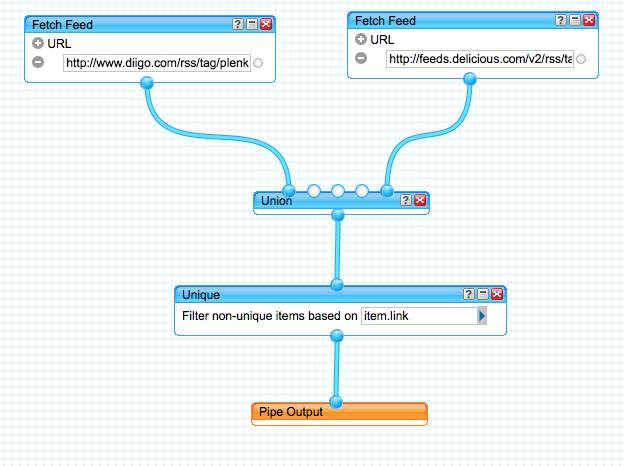
It’s quite simple. It takes the RSS feeds for delicious bookmarks tagged plenk2010 (http://feeds.delicious.com/v2/rss/tag/plenk2010) and diigo bookmarks tagged plenk2010 (http://www.diigo.com/rss/tag/plenk2010) and combines them in the union block. Now some people will be tagging in delicious.com, and others will be tagging in diigo.com, and some, like me, will be tagging in diigo.com, but will have set up their account to cross-post to delicious.com. With the possibility of people posting the same link in multiple places, we want to ensure that we avoid duplication, so we include the Unique block which filters the combined RSS feed to choose only those items that are unique in their link (that is their URL).

The result is displayed as a list, which you can see by following this link. You’ll note that Yahoo provides the output of this Pipe as an RSS feed, JSON3, a My Yahoo widget, iGoogle gadget, etc. It can even be obtained as a “badge” that can be embedded in a blog or VLE.

Very useful, I’m sure you’ll agree. But there’s a problem. If you look closely at the data, you will notice that there appears to be duplication. The same bookmark appears several times even though I’ve used the unique filter. What goes on?

If you look at the links, the answer quickly becomes obvious. It is because the person who bookmarked the resource explicitly or implicitly used a bookmark shortening service such as bit.ly, tinyurl.com, or even the bookmark shortening services of the bookmark services themselves.

Thus, one of the principle value propositions of social bookmarking, the identification and enumeration of resources that have been useful to many people, is being violated. And what’s worse, it makes my pipe less useful than it could be to me and my fellow #PLENK2010 students. Perhaps social bookmarking services and other link aggregation services need to de-reference shortened URL’s to avoid degradation of the uniqueness of the URL.


Notes

1URL (Uniform Resource Location) is is a URI (uniform resource identifier) that, “in addition to identifying a resource, provides a means of locating the resource by describing its primary access mechanism (e.g., its network location)”.

2 This has never been strictly true, for example Content Distribution Networks, web caches, etc can make it seem that the same URL points to many different locations.

3 JSON is a data specification for the web by which information, e.g. a blog post and its associated meta data, can be packaged as a text string that represents a JavaScript object.
A week in a MOOC

The first week of #PLENK2010 is nearly over. Just one Elluminate discussion to go (16.00 Zulu, 17.00 BST). This is my first Massive Open Online Course (MOOC) (it’s actually my first experience of any form of formal learning for quite some time) but despite all the dire warnings about information overload issued at the start, I actually think I’ve settled in quite nicely. I have read all the readings (and made notes!), read the interesting blog postings that have been published in The Daily, posted comments on a few of them, lurked in the forum and contributed here and there, shared bookmarks with the plenk2010 bookmark group on Diigo, and even contributed a couple of aggregation tools (see earlier posts this week). So, I think I am on top at the moment (though I must confess to being too scared to look at Tweetdeck for the #PLENK2010 hashtag).

Of the readings, I’ve found Alec Couros’s description of a PLN (Couros, 2010) resonated best with me:

personal networks are the sum of all social capital and connections that result in the development and facilitation of a personal learning environment.

I haven’t yet drawn my PLE – an activity that seems to be a rite of passage for this course – but if I did, it would look a lot like Joyce Seitzinger’s (@catspyjamasnz) excellent image that is available to view on Flickr.

Another interesting idea was expressed in Dawley (2009), a paper introduced in a discussion on PLE Competencies . She describes levels of engagement in social networks on a scale that goes from network discovery through to leadership via lurking, contributing, and creating. I like to think that I’ve stopped lurking and started contributing and creating. We’ll see if I can reach a leading role.

Next week, we move on to comparing PLEs with VLEs!

The new academic year starts for me on 27th September, and as I’ll have less time then, at least during the day, I will probably find that my participation drops off. But I hope not, because I think I’ve got a lot to learn and contribute.

References

Alec Couros, 2010. “Developing Personal Learning Networks for Open and Social Learning” in G. Veletsianos (Ed.), Emerging Technologies in Distance Learning, AU press, 2010. Available on-line.

Lisa Dawley, 2009. “Social network knowledge construction: emerging virtual world pedagogy”, On the Horizon, Vol. 17. No. 2. pp 109-121. Available on-line.

Comments:

Mrparkin - 637234 -

http://mrrlparkin.blogspot.com/


Chris Jobling -

Welcome back!


Ali 672227 -

http://al-ba7rain.blogspot.com/ ALI 672227


596139 -

http://jumanasdiary.blogspot.com/


Chris Jobling -

Welcome to the blogosphere!


Chris Jobling -

Welcome to the blogosphere!


Gary Ng Siu Chung -

http://allaboutfootballcrazy.blogspot.com/  Hi this is my blog!~


Chris Jobling -

Welcome to the blogosphere!


590529 -

http://590529.blogspot.com/


orakpo_valys -

http://590529.blogspot.com/


Chris Jobling -

Welcome To the Blogosphere!


Chris Jobling -

Hello!


Guo ziwen -

Hello Sir, Happy new year  welcome to my blog http://guoziwen.blogspot.com/


215295659 -

Hello Sir http://guoziwen.blogspot.com/  HAPPY NEW YEAR  WELCOME TO MY AREA


Chris Jobling -

Welcome Guo!


493076 -

http://psvtrans.blogspot.com/


Chris Jobling -

Welcome to the Blogosphere!


Megan -

Helloooooooooo http://megancastleton-icct.blogspot.com/


653764 -

http://icct-mobcomms.blogspot.com/


Chris Jobling -

Welcome Jenna!


Chris Jobling -

Welcome Megan


Google Custom Search Engine for #PLENK2010

At Tony Hirst’s suggestion (see comments to previous post), I followed Alan Levine’s instructions and created a custom google search engine derived from Stephen Downes ‘feed of feeds’ OPML file. It took a couple of attempts as it’s not clear on the Google Custom Search Engine creation page just what you have to do, and the order you have to do it, but with Alan’s post and a bit of perseverance I worked it out.

I am therefore pleased to announce that there is now a Custom Search engine (CSE) for PLENK2010. And it can be made into a gadget (for a blog, wiki, iGoogle, but not it seems for NetVibes!) which looks like this:

http://www.gmodules.com/ig/ifr?url=http://www.google.com/cse/api/009258780943241658166/cse/ywt59k2qnvc/gadget&synd=open&w=372&h=112&title=PLENK+2010+Feeds&border=http%3A%2F%2Fwww.gmodules.com%2Fig%2Fimages%2F&output=js

A word of caution, the search engine is based on the 133 blog feeds that, at the time of writing, Stephen had collected in the PLENK gRSS-hopper (which includes the twitter stream). It doesn’t restrict search to #PLENK2010 posts. To do that, include the term #plenk2010 in the search.

Try it!

Stop Press

@mhawksey added Google Instant magic using the techniques described in How to Google Instant(ise) a Custom Search Engine (CSE). See improved PLENK2010 Google Custom Instant Search. Nice!

Aggregator/Publisher for #PLENK2010


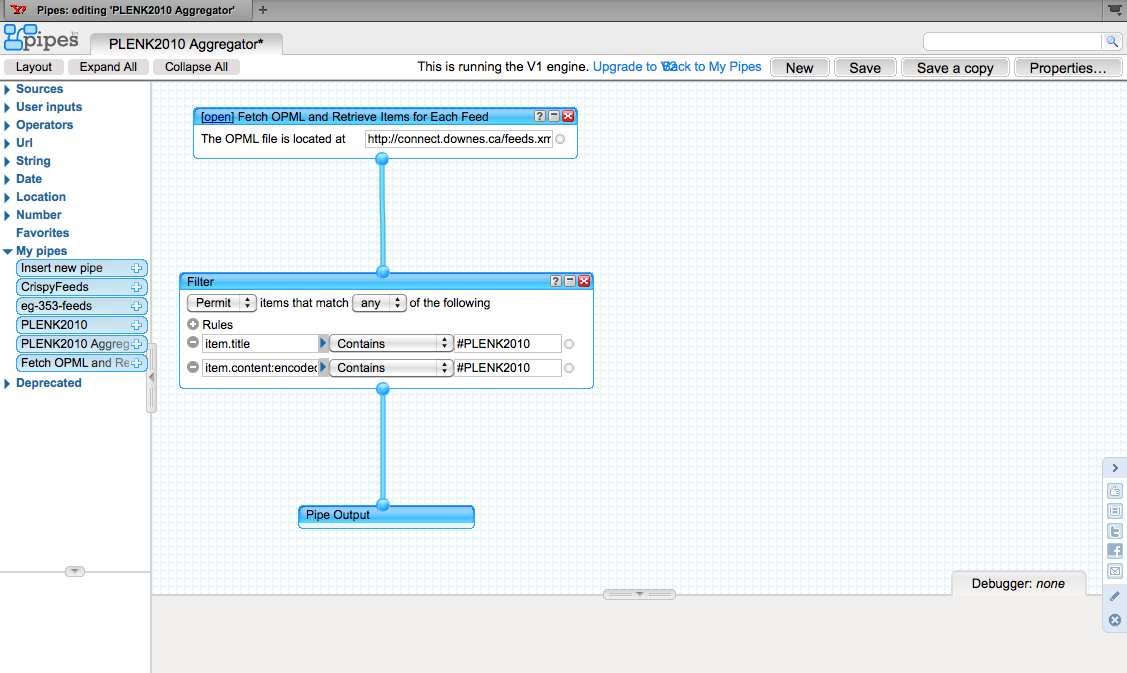
I have started putting together a personal learning environment for the Massively Open Online Course PLENK2010. Taking my inspiration from mashup-meister Tony Hirst, I have created an Aggregator using Yahoo! Pipes. This takes the OPML file (connect.downes.ca/feeds.xml) from the PLENK2010 Participants Feeds page, feeds it through a filter to extract posts with #PLENK2010 in the body or title, and produces a simple feed reader. The output of this can be obtained in various formats including iGoogle feed reader gadget, Google Reader, netvibes widget, JSON and RSS. It has to be said that the pipe is not very reliable: I suspect that obtaining and parsing the OPML file (which had at the time of writing, 100+ feeds), extracting the feeds and then filtering them causes time-outs on the back end, and Yahoo! doesn’t appear to cache the results between calls. Perhaps there’s a work around.

In a sense, my PLENK2010 Aggregator Pipe does much the same as Stephen Downes’ gRSS-hopper tool that is used to create the PLENK Daily and would be redundant if the filtered feeds from gRSS-hopper were available in RSS format. But on the other hand, Yahoo! Pipes can be used to create an aggregator for all kinds of web content, has has been amply illustrated by numerous blog postings in Tony Hirst’s OUseful.info blog, and might be a useful place to start building an aggregator for any other personal learning activity. And a pipes aggregator can easily be extended to take in live Twitter feed, photos, YouTube movies etc.

In my normal day-to-day PLE, I use Google reader to read the feeds from my sources. However, to avoid mixing my PLENK activities with my normal work, I thought I’d give Netvibes a try. Netvibes has a useful feature that allows you to create a new dashboard. Give it the keyword plenk2010 and it will create a set of pages that include widgets for blog searches, Google searches, twitter feeds, Youtube, Flickr, etc. all looking for the tag plenk2010. You can throw away the widgets (particularly the advertisement widgets) that you don’t want and you’re left very quickly with a good starting point for a custom PLE. I only needed to add the RSS feed from my Yahoo! Pipe and I was set. The result is what I assume would be a Publisher in Downes’s nomenclature (see Stephen Downes: Personal Learning Environments (Video)).

I’ve created a screencast showing My PLENK2010 Dashboard in Netvibes.

Starting with PLENK 2010

Today a Massively open Online Course (MOOC) on Personal Learning Environments, Networks and Knowledge (PLENK2010) is starting. The course is being facilitated by George Siemens, Stephen Downes, our own Rita Kop and Dave Cormier and is being used in various was to research PLEs and their effectiveness. Personally, I am hoping to learn more about Personal Learning Environments and Personal Learning Networks (aren’t they the same thing?); how I might exploit them in my own personal learning; and how I might adopt the ideas in my teaching.

There is no fixed approach so I expect that I will be using delicious to bookmark the course materials with tag plenk2010, twitter with hashtag #plenk2010 for quick responses and comments, and this blog for deeper reflection. If I find the need to pontificate in pictures, video or audio, I’ll use the appropriate free tools (respectively Flickr, YouTube and AudioBoo) and provide embedded copy here. The course provides a wiki and a Moodle forum but I’m not sure if I’ll be actively using those. Twice a week there’ll be presentations (Wednesdays) and discussions (Fridays) on Elluminate. There’s also a daily newsletter which will aggregate ideas and posts from participants.

If you’re reading this blog, you’ll note my PLENK related reflections because they’ll be tagged #PLENK2010. The course is open and you can still join by following the link given above. The course runs for 10 weeks. There are no credits but I hope that I’ll learn something!

If any of my readers are also PLENK’ing, perhaps you could let me know in the comments.

Comments:

My Open Story for #101openstories – Fresh and Crispy -

[…] suppose a breakthrough for me came as a ed blogger came when I joined the Connectivist MOOC Plenk 2010 in September of that […]


Larkin with Toads: A Personal Journey

Philip Larkin was the Librarian at the University of Hull and while I was a student there, I think I actually saw him once, striding imperiously through the Brynmor Jones Library. He was also a famous poet who died in 1985 and the City of Hull is celebrating the 25th anniversary of his death with a number of special events.

One of the more bizarre events is Larkin with Toads, the temporary invasion of 40 giant fibre-glass toads, a public art installation which celebrates Larkin’s poems of working life ‘Toads’ and ‘Toads Revisited’ (See Wikipedia article).

During the August Bank Holiday weekend, my wife and I took two days to wander around Hull to to try and see and photograph as many of the toads as we could. Usefully you can get a map for this from the City Tourist Information Office and online.

We also took the opportunity to try some real ale in Ye Olde White Hart, The Old English Gentleman, The Minerva Hotel and Ye Olde Black Boy.

I’ve put my photos on Flickr and here is a Slideshow of the toads. You can also view the toads on a map. If you want to see them for yourself, you’ll have to hurry, the installation ends at the end of September.

http://www.flickr.com/apps/slideshow/show.swf?v=71649

Gower Macmarathon 2010: Story of the Day

Personal success but failure for mobile technology!

8.27 (BST 7.27 GMT): On the Bus at Bracelet Bay, Mumbles. First trip report filed with Audioboo.fm:

http://boos.audioboo.fm/swf/fullsize_player.swf

#### Stage One: Rhossilli to Port Eynon, 7 Miles

09.22: Rhossilli, at the start of the walk, I filed my second report filed on AudioBoo.fm. There was no reception for quite a while!
Chris at the Starthttp://boos.audioboo.fm/swf/fullsize_player.swf

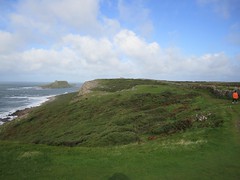
Worm's Head, from the other side The first stage of the walk, the coastal path between Rhossilli and Port Eynon is a distance of seven miles. There where a couple of ascents and descents that were made quite treacherous by the heavy rain that fell on the Thursday and Friday before the walk. Indeed, coast guards were in attendance on someone, possibly one of the Gower Macmillan walkers, who had come a cropper on the first muddy descent near Mewslade Bay. There was even a helicopter! No photographs, because we thought we had to be at Oxwich by 1.00 and so weren’t dawdling!

Stage 2: Port Eynon to Oxwich, 3 Miles

We arrived at Port Eynon at around 12.00. A cup of tea was very welcome. I tried to tweet a status report, but there was no signal.
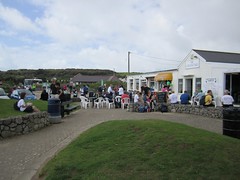
Port Eynon

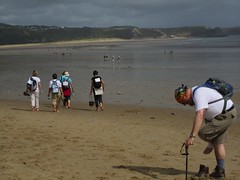
We arrived in Oxwich at around 13.25. We’d walked about ten miles from the start in around 4 hours five minutes. This made our pace around 2.5 miles a hour, which isn’t bad for the terrain. There was time to take on water before the next stretch which was to head out across Oxwich Bay to pass Old Tor into three Cliffs Bay at low tide. It was a welcome opportunity to take off my boots!

Chris at Oxwich Bay

Stage 3: Oxwich to Southgate, 4.5 miles

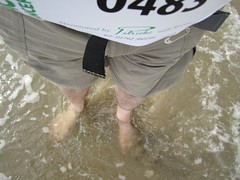
At around 14.11 we rounded the Great Tor and crossed into Three Cliffs Bay. The signal was good so I made another AudioBoo.fm report from the sea. Unfortunately the connection failed while uploading and I think the phone must have kept trying because my iPhone was dead by Caswellhttp://boos.audioboo.fm/swf/fullsize_player.swfMe in the Sea at Great Tor

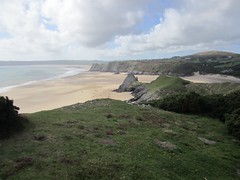
Overlooking Three Cliffs Bay
From Three Cliffs there’s a steep climb on sand dunes up to the cliffs above Pobbles Beach and it was about 15.00 when I had a chance to take this photo looking back over Three Cliffs bay, probably the most photographed spot in Gower. Southgate wasn’t far from here and we stopped for a coffee at around 15.30.

Stage 5: Southgate to Caswell, 4 miles.

On leaving Southgate, the Macmarathon walker has 14.5 miles behind and only 7.5 in front. It’s well over half way but there are still a few challenges on this picturesque stretch of the South Gower. The path descends through wood toward Pwlldu and crosses a bridge at Brandy Cove before rising again to meet the main road into Caswell.
Pwlldu Bay

Final Stage: Caswell to Mumbles, 3.5 Miles

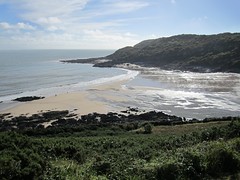
After a cup of tea at Caswell, we knew it was nearly over! We hiked over the coastal path out of Caswell, pausing for this photograph at 17.20.
On the Path Towards Langland
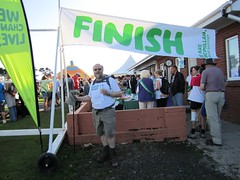
We entered Langland at about 17.35 and arrived at Mumbles Cricket club at around 18.05. Some 8 hours 45 minutes after the start. Tired, but not exhausted!
Chris at the Finish

Technology Issues

I wanted this trip to be a chance to try Twitter location feature and AudioBoo.fm. With no network coverage in South Gower, Twitter was a non-starter. Even though I recorded a couple of AudioBoo tracks, I wasn’t able to post the last one until the next day when the phone was recharged and I was back home on WiFi. So in future, I’ll have to rely on the built-in camera and audio recorder and upload reports after the event. Luckily, my camera has a decent clock and I was able to get the timings from the pictures that I took with it. I had to reconstruct the location information from the OS map.

More on the trip

I have published the complete set of photos on both Facebook and Flickr. Renate and I are still taking sponsorship and you’ll find the appeal page on-line at Just Giving. Thanks to all who have already contributed.

Ideas for posts

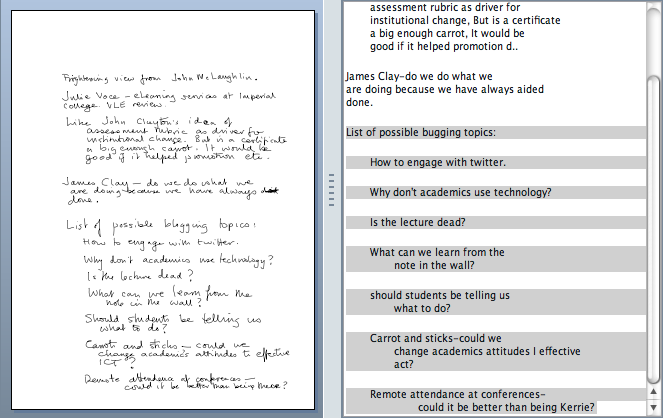
Apart from one or two errors, the translation of my scrawl on the left to the text on the right is pretty good!The 17th annual conference of the Association for Learning Technology ALT-C 2010 has just ended. And though I did not attend, I was fairly fully engaged with the keynote and invited sessions that were streamed via CrowdVine in Elluminate and will be made available on the ALT-C channel on YouTube.

Reflection starts now and I thought that I would use my newest e-learning gadget, my LiveScribe Echo pen, and trial copy of MyScript for LiveScribe to jot down and post some ideas for possible topics for this or the Swansea Learning Lab Community blog.

Here is the list of possible blogging topics (mostly questions rather than answers note):

- How to engage with Twitter. - Why don’t academics use technology? - Is the lecture dead? - What can we learn from the hole in the wall? - Should students be telling us what to do? - Carrot and sticks: could we change academics attitudes to effective ICT [for learning]? - Remote attendance at conferences – could it be better than being there? - Using LiveScribe or similar in lectures (as a lecturer rather than as a student).

Hopefully, this page will serve as a reminder to think about and write some of these up over the coming academic year.

The discussion will no doubt continue for a few days yet in the Twitterverse (tag #altc2010), on Cloud Works, and in Facebook.