Posts tagged with "Uncategorised"

Diaspora: one network to rule them all? Or one too many?

Alan Cann today announced the availability of the alpha release of the new distributed social network Diaspora. It’s seems to be available without the need for invitations and you can get an account by registering at http://diasp.org. Once registered, you’ll have a handle: mine is cpjobling@diasp.org.

One unique selling point (USP) is that Diaspora has ways of organizing your various networks around aspects of your social networks. In my case, as well as the default Work and Family aspects, I’ve created an aspect for PLENK2010 and e-Learning folks. Another obvious one would be an aspect for the Swansea Learning Lab. Once these are set up you can post messages that will be received by all or a selected sub-set of your contacts. This has the potential to be much more powerful than the everyone’s my friend model of Facebook and Twitter.

Another USP is that, when it’s finally released, it will be possible to host your own Diaspora server which will be able to link into the network of Diaspora servers.

To use Diaspora, you need to be using a modern browser (it’s an HTML5 application) and should probably expect user interface changes, bugs and intermittent availability. At the moment it supports status reports, aspects, chat, and photo sharing (by file upload). You can also link your Diaspora account to Twitter and Facebook and control messaging to these.

It will remain an open question as to whether Diaspora will become the social network or whether it’s a case of one too many.

SOCRAIT: If they build it I will come

Those of you who are regular readers will know that I spent 10 weeks from September to November immersed (almost literally) in the Massive Open Online Course (MOOC) on Personal Learning Environments, Networks and Knowledge (PLENK2010). As already reported, one of the highlights for me was the guest appearance of Maria Andersen and her intriguing proposal for developing SOCRAIT, a Socratic questioning layer on the internet consisting of a Learn This button, a social gaming-like motivation and reward system, and channeled expertise designed to provide a personalized learning for the masses. A disruptive technology indeed!

Well, a pre-print of Maria’s paper The World is My School, due to appear in the January-February 2011 issue of The Futurist, has just been posted (http://bit.ly/socraitpdf) and Maria is looking to spread the word virally using the twitter hashtag #SOCRAIT.

I invite you to read Maria’s paper and use the comments to answer these questions:

  • Could a system like SOCRAIT work?
  • Would you use it?
  • How would you implement it?
  • Could you see yourself using it in your own learning?
  • Could you adopt it in your teaching?
  • Would it be disruptive?

I’m pretty certain that if someone builds SOCRAIT, I will use it.

What I learned in PLENK2010

Short answer … not much. At least that’s how it appears to me at the moment.

I do know that I’m all PLENKED out, somewhat depressed and not looking forward to immersing myself in #jiscel10.

Perhaps it’s a symptom of SAD, or maybe I’m just in mourning.

Socratic questioning - Week 7 in #PLENK2010

Socrates

Week 7 in PLENK2010 was concerned with PLE/N tools (What Exists, What is Being Built?):

Many of the tools that fit under the PLE/N umbrella have been appropriated by educators from other fields. This isn’t necessarily a problem, but it does reflect a sense that educators are not building tools for themselves. The software that we use in this course is a bit of an exception. We [the facilitators] rely on various open source tools (Moodle, WordPress), proprietary tools (Elluminate), and tools that have been developed with feedback from facilitators and experiences in other open courses (i.e. Stephen [Downes] has written the software for The Daily and content aggregation – gRSShopper).

To use these tools for teaching and learning requires a certain skill set on the part of end users. Two significant challenges exist for educators and PLE/Ns:
1. Create new tools – what do we need? What functionality is missing in PLEs? 2. Improve end user experience – new tools, new interfaces, and ease of use.

For me, the highlight of the week was the Wednesday discussion (Elluminate recording here) in which Maria Andersen presented her ideas on a new transformative personal learning idea Learn This based on the simple idea that “learning should simply be by way of Socratic questioning, where questions are rephrased as answers.” [1]

Knowing little about Socrates, the Socratic method or dialectics (apart from a vague recollection of an episode of In Our Time), I was keen to explore how the Socratic questioning might work. So I turned the week’s questions into a discussion Socratic questions about PLENK in which I posed the questions:

  • What new tools do we need to create?
  • What functionality is missing in PLEs?
  • How could we improve the learner’s experience?

The discussion that followed has been wide ranging and extremely interesting. It even attracted the spirit of Socrates himself. Furthermore, it is still ongoing, so I will not attempt to summarize it here.

As PLENK moves into Week 8 (Personal Knowledge Management) I’m still not sure what a personalized learning system based on “Socratic questioning where questions are rephrased as answers” would look like in practice. But herewith, I open up the debate to a wider audience.

Reference

[1] Andersen, Maria H. “The World is My School.: welcome to the Era of Personalized Learning”, (to appear in The Futurist, Jan/Feb 2011). See early draft: Holy Grail in Education.


Image of a bust of Socrates by Victor Wager, University of Western Australia, Crawley, Western Australia. Photographed by Greg O’Beirne. Part of the Wikimedia Commons.

I, The Thinker

At PLENK2010 participant Heli Nurmi’s request (see Test Your Blog Please), I submitted the URL of this blog to http://www.typealyzer.com/ to have it subjected to a Myers-Briggs personality test. It turns out that these scribblings reveal me to be an INTP type (The Thinker)

The logical and analytical type. They are especially attuned to difficult creative and intellectual challenges and always look for something more complex to dig into. They are great at finding subtle connections between things and imagine far-reaching implications.

They enjoy working with complex things using a lot of concepts and imaginative models of reality. Since they are not very good at seeing and understanding the needs of other people, they might come across as_* arrogant, impatient and insensitive_* to people that need some time to understand what they are talking about.

Image Source: http://en.wikipedia.org/wiki/File:The_Thinker,_Rodin.jpg

I’ll have to think about that!

Week 7 in PLENK2010


Week 7 in PLENK2010
Originally uploaded by Chris P Jobling

Week 7 of PLENK2010 is all about the tools. I subject about which I believe I actually have some expertise.

Though the concept of the personal learning environment has been around for the last five years, there has not been a comprehensive summation of what has been developed in the field. We would like to build that summation this week.

Now what tools do we use to build a summation? Is this a job for the wiki which has thus far been sadly underused? Or will we mind map? Google doc?

The Unconceivability of Digital Literacy

You keep using that word. I do not think it means what you think it means.

– Inigo Montoya, the (film of) The Princess Bride. Novel and screenplay by William Goldman.

Week 6: (digital) literacy (skills)

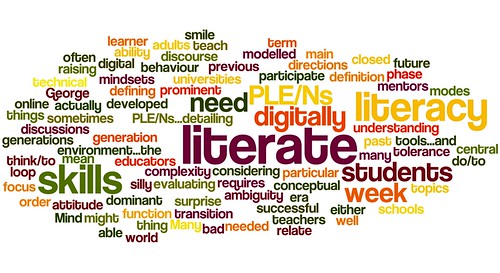
This week, I was in Gegynog at the final meeting of the Gwella participants. While there, a few people mentioned the phrase digital literacy. A variation of the phrase cropped up in the introduction to the readings for Week 6 of #PLENK2010 (see the Wordle above). It’s also a key theme of Robin Good and Howard Rheingold’s post New Media Literacy in Education which was one of the readings. Furthermore, it popped up in Wednesday’s discussion as reported earlier.

Like the Dread Pirate Roberts who keeps climbing the sheer cliffs after Vizzini has cut the rope:

HE DIDN’T FALL? INCONCEIVABLE?

The persistence of this phrase makes me think that it’s a topic that I can get my teeth into for the remaining four weeks of PLENK 2010. Perhaps I’ll be able to find out what it means.