Posts tagged with "Uncategorised"

Diigo group and Pearltree for CCK11

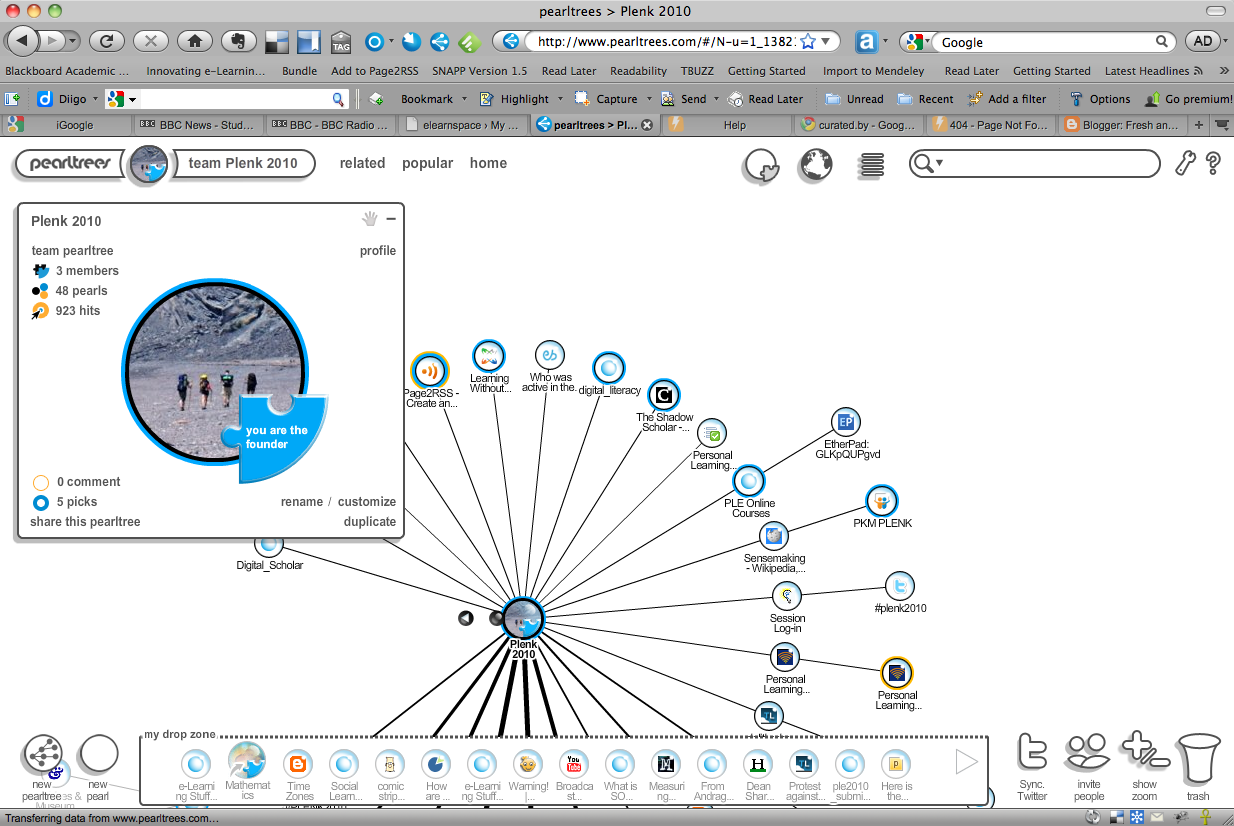
A couple of small things:  I’ve created an open public Diigo group for Connectivism and Connected Knowledge 2011 which you can use to share useful bookmarks (http://groups.diigo.com/group/cck_2011) and a team Pearltree (http://pear.ly/JgB5). I won’t have much time to contribute to CCK11, but I’m hoping that my network will help me by curating the must see resources that I might not have time to do for myself.

As Karen Stephenson (cited in Siemens 2005) says:

“Experience has long been considered the best teacher of knowledge. Since we cannot experience everything, other people’s experiences, and hence other people, become the surrogate for knowledge. ‘I store my knowledge in my friends’ is an axiom for collecting knowledge through collecting people (undated).”

References

  1. Siemens, G. “Connectivism: A Learning Theory for the Digital Age“, International Journal of Instructional Technology and Distance Learning, January 2005.
  2. Stephenson K (Internal Communication, no. 36) What Knowledge Tears Apart, Networks Make Whole. Retrieved January 19, 2010 from http://www.netform.com/html/icf.pdf.
Digital Story Telling: Assignment 1

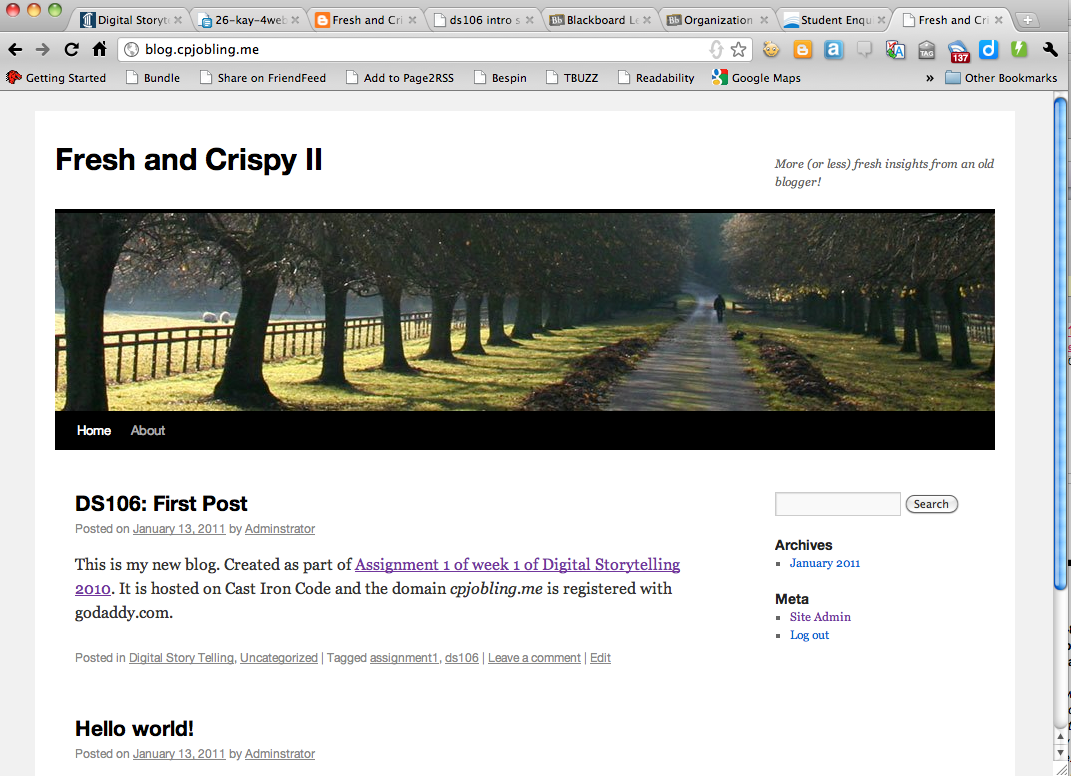
As part of the first week’s assignment we’ve been asked to set up our own webhost and domain. I’ve registered a new domain cpjobling.me with Godaddy.com and a signed up for the minimum hosting package from cast iron coding (CIC). I’m waiting for my confirmations to come through, then I’ll be setting up my name servers using the instructions provided here and WordPress blog using the instructions given here. Everything went fine and now I have a new Word Press blog which may one-day replace this one: blog.cpjobling.me.

I could (and have) done this manually on my own server, but the experience of using a hosting service and domain registration provides some good experience.

Ning Reunited

I’ve just joined the Evaluation of Learners’ Experiences of e-learning Special Interest Group (ELESIG) which is based around a Ning site (elesig.ning.com).  After Chris Hall and David Williams launched a Gwella group, I’ve noticed an increase in activity and the community that is developing looks to be quite exciting.

Was I wrong to reject Ning when they removed free access?

Should we have stuck with Ning for SALT and the Learning Lab?

For One Week Only: King James Bible

2011 apparently marks the 400th anniversary of the publication of the King James Bible. To mark the occasion, the BBC made a bit of a splash last week with a sequence of three forty-five minute documentaries fronted by James Naughtie on the commissioning, translation and legacy of the bible. These were followed by 7 hours of readings from the King James Bible made by the great and the good of the acting professions and introduced by well-known luminaries of literature and history.

For five days more, the whole lot is available from the special BBC King James Bible site and on the iPlayer. You can also download the readings (in twenty minute chunks) as a Podcast episodes which you can download to keep forever.

I’m not religious, but this is nonetheless a great listen for lovers of English and History and the podcasts are a great resource.

Apparently there’ll also be a series of documentaries on BBC 4 soon.

Time for a new MOOC?

Jim Groom is getting ready to launch another massive open online course (MOOC). Tony Hirst, who drew my attention to Jim’s course Digital Storytelling (ds106.us) with this post: Massive Open Online Courses all you need to know, has curated a few videos from PLENK2010 facilitator Dave Cormier on the philosophy of a MOOC.

I’ve signed up for Digital Storytelling, but I expect my role to be more as a lurker than turned out to be the case on PLENK. One reason for this is that my workload is likely to be crazy in early 2011. But we’ll see. The course is due to start on January 10th, 2011.

Of technical interest is that Jim’s MOOC is going to be facilitated via a course platform based on WordPress. There may be some lessons to be transferred to my institution which is looking to create a new community of practice around that platform.

Things to Do

Next year I’ve got a fairly busy schedule. Here are some things that I might be blogging about. I record them here as an aide memoir:

  • Large group assessment
  • The “Flip”
  • Socratic questioning
  • Peer Instruction, Assessment and Support
  • LiveScribe Echo
  • Social networks
  • Student employability and entrepreneurship. 

Technically, I expect to be playing with Drupal, WordPress, BuddyPress, Moodle and Elgg and maybe, if there’s time, Ruby on Rails 3. I might submit something (probably a poster) to ALT-C 2011.

I also realise that I should take the opportunity to take a look back at a year on Fresh and Crispy, so expect a post on that before December 31st.

Lookback at 2010: Tool of the Year

In the media, as the shortest day approaches and with it the end of the old year, it’s traditional to look back. Here is the first of my retrospectives on 2010.

My tool of the year is Pearltrees (http://www.pearltrees.com), which I discovered during PLENK2010. I’ve used this as both a curation tool (see my Plenk2010 collection) and as an exploratory learning object builder but it also has a social network discovery and connection building capability and recently added a group/team curation feature. It also provides a set of well designed browser extensions that make it a joy to use. Pearltrees is the best tool to come out of France that I’ve seen and deserves to be better known. Its one disadvantage … it uses Flash so won’t work on the iPhone or iPad! Maybe there’ll be an “app for that” one day.

Other tools discovered or rediscovered this year worth mentioning:

  • Twitter and Tweetdeck became part of my life!
  • Amplify has great potential.
  • Google forms came to the rescue when a bespoke application that I wrote failed under load.
  • Google presentations did what SlideShare couldn’t.
  • Elluminate became important several times this year, but I fear that it’s licensing costs will kill it now that it’s owned by Blackboard.
  • iPhone and podcasts — education for the 15 minute commute.

To Lurk or Not to Lurk, That is the Question

There’s an interesting debate forming around this post from George Siemens (My Personal Learning Network is the most awesomest thing ever!!) and a response from Jenny Mackness (In defence of lurking).

George’s stance is that you can’t really learn in a community unless you are contributing something, Jenny’s that it’s OK to observe and not contribute. There are lot’s of other interesting points of view expressed in the comments.

To me, I feel I got more out of PLENK2010 by being an active contributor, although in the end I wasn’t sure if I’d learned that much. I think there’s a parallel to be made with large group teaching as a whole: in a lecture of 250, it’s going to be a brave soul who contributes. Perhaps the same is true of a MOOC. Maybe, PLENK2010 was just too big, and the people who “lurked” will be active participants next time. Maybe, it needs to be M for “medium-sized” rather than “massive.”