Posts tagged with "Uncategorised"

Blackboard 9.1 Tips - #1 Campus Pack

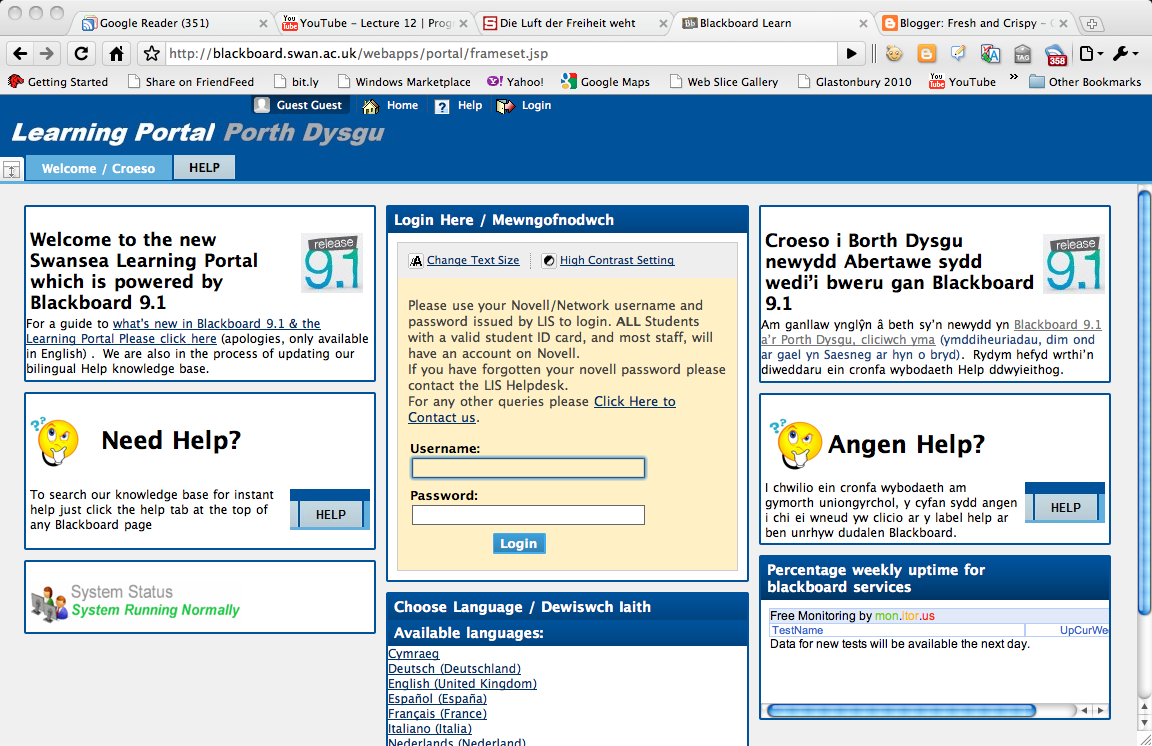
Learning Objects Campus Pack, used to provide for blogs, wikis and podcasts in Swansea University’s VLE, was updated at the same time as Blackboard. If you have one or more Learning Objects blog(s), wiki(s) or podcast(s) in your Blackboard (learning portal) module sites, they will be upgraded the first time you or your students visit them.

If you have a large number of these installed in a module site, as I have for some of my modules, you may want to do the upgrade before your course is opened for new enrolments. That way, you will avoid confusion for your students and any colleagues you may be sharing a module site with.

Blackboard flag day

Today is the day when Blackboard 9.1 was rolled out at Swansea University as the new Learning Portal. I haven’t logged in to check my courses yet, but I’m sure they’ll be fine.

Clive and his team promised to deliver the update on July 30th, and that’s what they’ve done.

I know a lot of planing and work has gone into this and it’s been done with minimum fuss and negative impact.

Great job guys!

Great Teaching

I love this video from the first lecture of CS 106A Programming Methodology (Recorded in Fall 2008). Apart from the enthusiasm of the lecturer Mehran Sahami, which is infectious, it’s a great source of inspiration for learning and teaching:

- Grading without numbers - The Stanford Honour Code (approach to Plagiarism) - Use of undergraduates for peer/mentor support (even grading!) - Use of sugary snacks as rewards for contribution - Use of continuous assessment with later work given more marks to encourage work to the end - Midterm tests - Personalized feedback via “interactive marking” - 2 Free days for late submission of coursework – avoids extensions.

Not sure how we could do it all … but there must some of this which has to be worth trying. The video embedded below is hosted on YouTube and can be downloaded and redistributed under a Creative Commons (Attribution-Noncommercial-No Derivative Works) license.

There is a YouTube channel for the whole course.

The follow-on course, CS106B Programming Abstractions (See YouTube channel for CS106B), was also recorded in the 2008 academic year. The lecturer that year, Julie Zelenski, is also a great performer, but the course is also worth noting because it’s the first example I’ve seen where there’s a Facebook link page embedded in the course web site.

Mathemagic (part the first)

This code snippet on calculating the first n Primes using the Python programming language fell into my RSS feed this morning. Very nice I thought, but then it occurred to me, what would be really fast would be to ask the internet. Or more specifically WolframAlpha. So I did: http://www.wolframalpha.com/input/?i=primes+less+than+1,000,000,000.

The first 20 of 50,847,324 prime numbers less that 109 are displayed in the internet equivalent of a blink of an eye.

One assumes that Mathematica is doing the sums in an efficient way so you get the benefit of expert algorithm knowledge *and* get right to the answer just by asking the obvious question “primes less than 10,000,000,0000″.

You also get to know how many of them there are, and if you want, you get a PDF listing them that you can use to wallpaper your room.

Prime numbers are very interesting. Wikipedia has a fairly detailed introduction. Asking WolframAlpha about “primes” gives you some basic information and examples of useful queries and there’s loads of information about Prime Numbers at the Mathematica Mathworld website. Marcus du Sautoy talks about prime numbers (the “Atoms of Mathematics”) in this video. There are also a number of ways of testing for finding prime numbers using Prime Factorization and many efficient, and less efficient, ways of doing Prime Factorization with a computer.

Incidentally, is the Python algorithm really the fastest way? What does *Mathematica* do? Answers, with proofs, in the comments!

OSCON 2010

The O’Reilly Open Source Convention (OSCON 2010) took place last week in Portland Oregon. Videos of the talks are being published on YouTube and Blip.TV. Taken with the convention site, the various related blog postings and twitter feed, there’s lots of useful information.

What stood out for me in the video feed was Daniel Recordon’s talk “Today’s Lamp Stack” which describes how Facebook’s has been implemented on the LAMP stack. It’s a talk that will be useful as a learning resource for my course on Web Applications Technology.

For ease of access, I include the embeddable version here.

[blip.tv http://blip.tv/play/AYHwpRwC]
The learning message is that there’s a lot more to hosting a big site like Facebook than Linux, Apache, MySQL and PHP!

Podcast of the Week #1: E-Learning Stuff

I read a lot of blogs and I listen to a lot of podcasts, so I thought I’d use this blog to tell you about some of my favourites. Here’s the first of an occasional series of recommendations: It’s e-Learning Stuff and the associated e-Learning Stuff podcast from James Clay, ILT & Learning Resources Manager at Gloucestershire College, and 2009 winner of the ALT Learning Technologist of the Year.

I am an early adopter and self-confessed geek. I love new technologies and often try to find ways to incorporate them into my teaching (and personal learning). But as an *educator* rather than a *learning technologist*, the bottom line for me is that I want my students to gain value from my experiments with e-learning technology. The technology should not be an end in itself. As such, I’m only on the periphery of the e-learning technology community. A guest, rather than a fully paid up member, if you like.

I have a digital identity and a personal learning environment that extends across this blog and my Facebook, Twitter, Posterous and FriendFeed accounts. I aggregate my Google shared items, Buzz, delicious account, Flickr, YouTube, SlideShare and Prezi to my FriendFeed. But despite all this, I still spend a frighteningly large amount of time in the institutional Virtual Learning Environment (Blackboard in our case). I tend to bring resources *into* the VLE on the basis that that’s were I assume students will be coming to find them, rather than trying to work outside it.

To the e-learning community, the VLE is like bronze-age technology that should have been made redundant by the dawn of the machine-gun age. But if most HE institutions are anything like mine, bronze-age weaponry is well in advance of the stone-age (should that be *chalk*-age) technologies that most of my colleagues are wedded to. It’s therefore refreshing to find learning technologists who are as pragmatic as James is. Sure, he likes his toys, but he also knows where the real world is at. His blog, especially his posts on 100 ways to use a VLE, is inspiring, and his podcast, usually consisting of a discussion with colleagues from the FE community mixed with the occasional recorded conference keynote, is genuinely interesting.

Recent highlights from the podcast include:

- I Haz iPad Too - Engaging with the VLE - The VLE Lives - Keep Calm and Carry On - The VLE is Dead

You can, or course, subscribe to the podcast at iTunes.
On my radar

I’ve just got back to work after breaking my ankle five weeks ago and I’ve just started catching up with things in e-learning and beyond. I thought I’d enumerate a few things that are on my radar. Just a list with links for now:

- Blackboard 9 coming soon to Swansea U. - Delicious Bookmark Browse feature (thanks to CogDogBlog). Useful for creating a presentation based on web sites. Try this one for resources I’ve collected on plagiarism. - Open source learning object building toolkit Xerte (thanks to Helen Davies at the Swansea Learning Lab). - The WolframAlpha search engine from Wolfram research (and *Mathematica*). Good introduction and interview with Conrad Wolfram in the June 9th Edition of the Guardian Tech Weekly Podcast. Try: http://www.wolframalpha.com/input/?i=7+May,+1959. - EduGlu — a social network builder for education based on Drupal. Very early stages of development, but one to watch.

Swansea U leaps two places in The Guardian league tables

The Guardian league table claims to rate Universities by student satisfaction. It gives higher scores to “value added”, overall satisfaction and feedback (the latter two by results from the National Student Survey), money spent per student, entry grades, careers prospects and staff-student ratio, than other ratings such as research quality which other newspapers (and Universities themselves) like to emphasize. It does this because, as it says in yesterday’s article supporting the release of its 2011 league tables “Oxford tops Guardian’s 2011 university league table“

The tables provide vital information for the more than 600,000 university applicants who this year [because of HE budget cuts] face the toughest ever competition for places.

Swansea University is in the uncomfortable position of being 93 of 117 institutions, above only Glyndwr and Newport in Wales (Swansea Metropolitan is not listed), and well below the institutions we strive to compete against for research rankings.

The creation of the Swansea Academy of Learning and Teaching (SALT) and its emphasis on changing the tide on retention, student engagement and feedback, might help. But as the 2011 league tables are based on 2009 figures, it will take time for any improvements we make to filter through. And everyone else is playing the same zero-sum game!

We can take some small consolation on having improved our position by two places (we were 95 in the 2010 tables) but with severe cuts expected in higher education spending, which may well mean doing more with less, I can’t see much else to smile about.

Welcome to Higher Education, Austerity style!

Google I/0 2010: Google TV

The second part of the Day 2 Google I/O 2010 keynote introduced Google TV. Google seemed very excited about this and rolled out the CEO and representatives of Sony and Logitech who will be first to market with the technology, BuyMore, who hope to make millions selling it in the run up to Christmas 2010, and a US satellite company (not Sky) that will have some support for it.

I have to admit to being somewhat underwhelmed. What Google TV is, after all, is just a glorified web browser in a box that can put its signals onto your TV. If you have the cables, you can do this with your PC now, so where’s the value added?

Well it will allow access to the whole Internet, it won’t be a walled garden so that’s good. It’ll play well with your android phone (which can even act as a remote) and it is based on android itself so it can run android apps as well as web apps. It’ll also be able to put Google ads on the biggest screen in the house, so I can see why Google would be excited. Potentially it could put the Internet into the hands of people who don’t have access via PCs (although it will require a broadband connection into the house so it would be interesting to speculate if such a household really exists), and it could be a way to improve the interactivity and educational potential of the “Watching TV” experience.

It won’t be available in the UK for a while I assume, so we’ll have to judge its success by what the US consumer thinks of it. If I upgrade my TV in the next year or so, I’ll be looking for HD and won’t be holding off until the Google TV product arrives in the UK. For this reason, if I was a betting man, I’d expect the sale of Logitech “companion” box to exceed sales of Sony Google TVs by an order of magnitude.

Furthermore, the video of the Google TV keynote (currently available only as a Google play list) loses some of its impact because licensing restrictions meant that video of demonstrations of actual TV programmes couldn’t be released. So we only get to see the web features (it’s just a big web browser!) and the android stuff! This may be part of the reason why I’m underwhelmed — perhaps this is a genuine case of “you had to be there”.

I have to admit to being a little disturbed that Google’s domination of the web ad market is moving to mobile phones (see Android Keynote) and now the TV. Shouldn’t that be making us all nervous? If we are exposed to or watch a Google ad on TV, or on our phones, the advertisers and Google will know where and when and in what context.

That’s scary!

Google Chrome Web Development Tools


If you are like me you like Google chrome because it’s fast, up-to-date, standards compliant and fast. But if you are a web developer, you need to use Firefox because it has Firebug, the best web development browser extension there is.

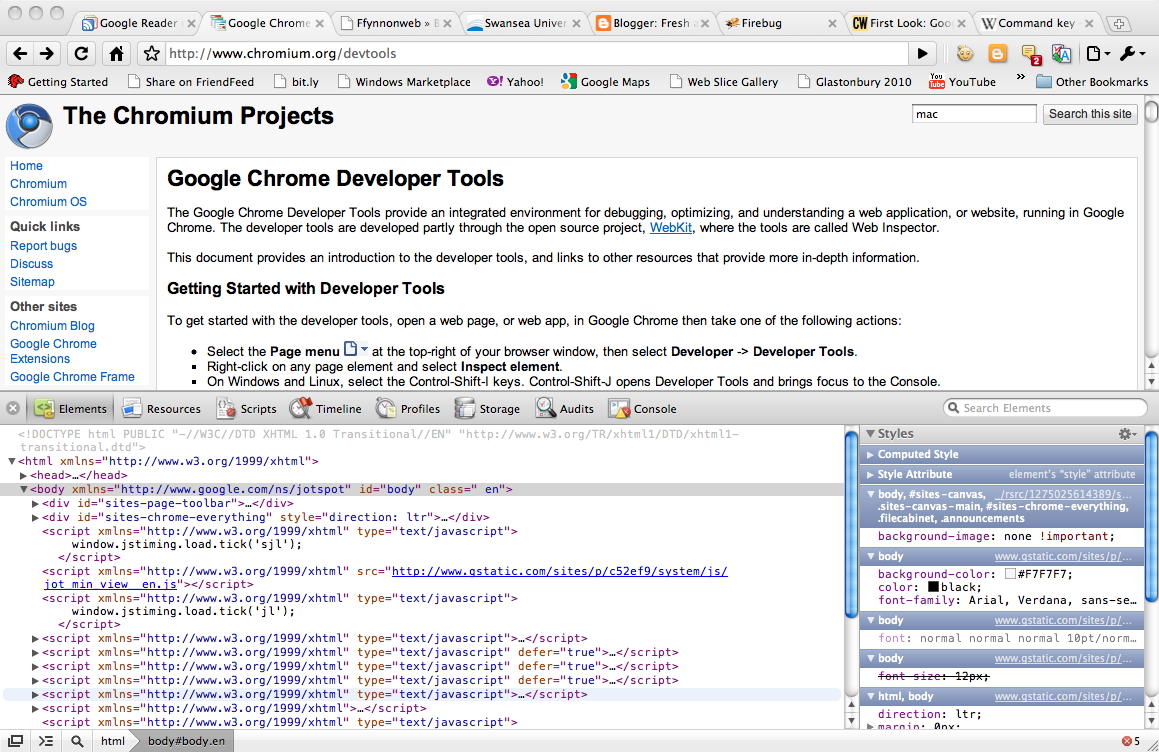
Well, it turns out that Chrome provides some built-in web developer features extensions that I stumbled upon the other day quite by accident. The image shows the developer tools open and at the code view and CSS inspector.

The Google Chrome Developer Development page gives an introduction to the facilities and it contains are a number of videos that demonstrate what you can do with them as well as an detailed tutorial. This blog posting introduces the google chrome developer tool and additional web developer extensions that can be used to extend the web development capabilities of the browser.

Now if there was only the equivalent of Xinha and a proper Delicious bookmarking extension, I might never use Firefox again.

*Note for Mac users*: the page and tools menu are not turned on by default. The developer tools are hidden behind the view View -> Developer -> Developer tools menu. This explains why I only stumbled across them by accident. You can turn on the tools and page menu in by selecting Preferences from the Chrome menu (?,).

**Stop press**: There is now a beta version of the official Delicious Chrome extension and it’s now installed! Let me know if there’s one for Xinha in the comments.