Recent Posts

Google docs launches presentation tool

And Common Craft tells you why it matters!

On on Tuesday 18th September, Google announced the arrival of a new collaborative presentation tool which they call simply *presentation *. Annew member of the Google Docs suite (which already includes a collaborative Word Processor and a Spreadsheet application), *presentation* provides a web-based tool for creating and developing presentations. It’s not as capable as PowerPoint, but probably passes the 80-20 rule. Plus it’s collaborative (you can share presentation development duties with others) and web publishable. Here’s a quick and dirty presentation I made to test the tool and its sharing capabilities. If you’d like to test it’s collaboration capabilities, leave me a comment with your email and I’ll share it with you. In a carefully timed release, our friends at Common Craft, released another “plain english” video to explain why collaborative tools like Google Docs are important. It’s Google centric (presumably Google commisioned the video), but the central tenets apply to other collaborative systems even *sharepoint*. Are you ***listening ***dear colleagues of mine!

Here’s the video:

Powered by ScribeFire.
I've Made a DokuWiki Plugin!

I have just created my first DokuWiki plugin (in fact it’s my first PHP program!). It provides a way to mark-up Command Line Interface (CLI) transcripts, such as UNIX shell sessions, etc for user documentation. I’m using it to format a UNIX tutorial for my students, but it could be used for other things. For some examples see: test:cli. For the plugin itself see plugin:cli at the DokuWiki plugins repository.

Powered by ScribeFire.

Air Display in Swansea

Renate and I watched the Red Arrows from Swansea Beach today. The display was part of a two day Air Display put on by the Royal Air Force (RAF) and Swansea City and County Council. I took a little bit of footage on my little Canon IXUS 50 and I edited the footage into a little movie which I uploaded to YouTube.

I’ve also uploaded a few photos to Flickr. Enjoy!

Thoughts on "First Programming Languages"

Howard Lewis-Ship has blogged about the recommendation of Java as a First Language. This is a topic that has been exercising me for a couple of years (although I no longer teach an introductory programming course). Howard is right when he states that: > Java is extremely monolithic: in order to understand how to run a simple Hello World program, you’ll be exposed to: > > > - Classes > - Java packages > - Static vs. instance methods > - Source files vs. compiled classes > - Editing vs. Execution > - Using a compiler or an IDE > - Method return types and method parameter types > - The magic (for newbies) that is “System.out.println()”

For a while I was content to go along with the BlueJ “objects first” approach which seeks to hide some of these details behind a graphical user interface. But having observed the experiences of students who find it difficult when they need to graduate from the “training wheels” of interactive objects on the screen to raw unadorned, *textual*, Java code, I’ve been having doubts. Howard himself advocates ruby, and interestingly the inform language (that seems to be designed for creating virtual worlds). This year, I am supervising a student project evaluating python so expect more on this topic.

Powered by ScribeFire.

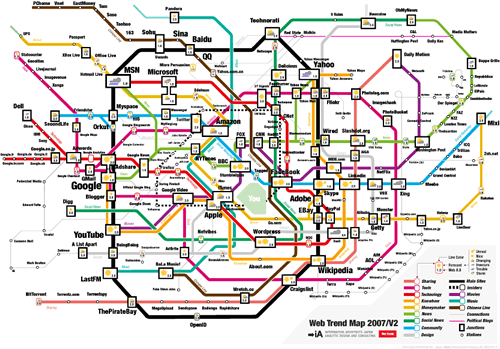
Tube Map of the Internet


Discovered yesterday in my massive “first-day back” trawl of my RSS feeds was this interesting visualization of the most important web destinations shown as an underground or metro map (actually based on Tokyo’s I believe). One version is a clickable image (with pop-up snap shots of the sites themselves) that you can use as a browser start page which should provide hours of fun. You can also get PDFs that print the map in A3 size as well as the possibilty to buy A2 posters, use it as a desktop image or a screen saver (Mac OSX only!). The map was develoiped by Information Architects, a “strategic design agency” located in Tokyo, Japan.


Comments:

Dave Ferguson -

Chris, I'm glad you enjoyed the experience overall. Yes, a tweet chat, like Twitter itself, is a flood. I try and think of it as a river rather than a firehose: I can swim through it, or watch it flow without plunging in, or wander off and come back. As @heraclitus would have been surprised to see, you can step into the same stream again, thanks to search and archive tools. LOL (as Google's probably told you) is "laughing out loud," one of dozens of such shortcuts that emerged in the dawn of online discussion (usenet, IRC, CompuServ, what have you). Your readers may want to know that #lrnchat happens twice a week, on Thursdays, at first at 11:30-1pm EDT/4:30-6pm BST and then again at 8:30-10pm EDT, which is VeryLate:30 BST. More at lrnchat.wordpress.com/about.


Julia Ault -

I thought everyone had a pet rock at one time Chris! I have always taken LOL to mean Laugh Out Loud myself.


Chris Jobling -

I did too but you never know if those sneaky youngsters haven't made it something rude!


Inbox Zero

It’s been a while but I’m sort of back in harness after my vacation (even if actually at home in my pyjamas). One of the issues that always occurs after a period away is dealing with the email after a period away. To this end, this video by Merlin Mann of 43folders may help. It provides some useful tips about how to deal with after-vacation email as well as the ongoing problem of dealing with email on a daily basis. It comes down to a simple strategy for processing email: empty the email inbox every time that you visit it. You do this by some variation of a processing procedure that does one of these five things with each message:

  • delete (or archive)

  • delegate

  • respond

  • defer

  • do

Watch the video for more detail and for the interesting discussion (with Google knowledge workers) and be inspired!

http://video.google.com/googleplayer.swf?docId=973149761529535925&hl=en-GB

Arthur Austen Prize


At yesterday’s School of Engineering Graduation Reception, Multimedia Technology graduate Andrew Robinson was awarded the Arthur Austin Prize. Andrew is accompanied by Professor Nigel Weatherill (Head of School), Jim Lindley, Honorary Treasurer of the Wales South West Local Branch of the Insitution of Engineering Technology, and me.

Arthur Austin was a long serving member of the South West Wales Branch of the IEE and was a pioneer in cinema. The award is named in his honour and is a gift of the Wales South West Branch of the IET. The photograph was taken at Fulton House, July 19th, 2007

Graduation Day


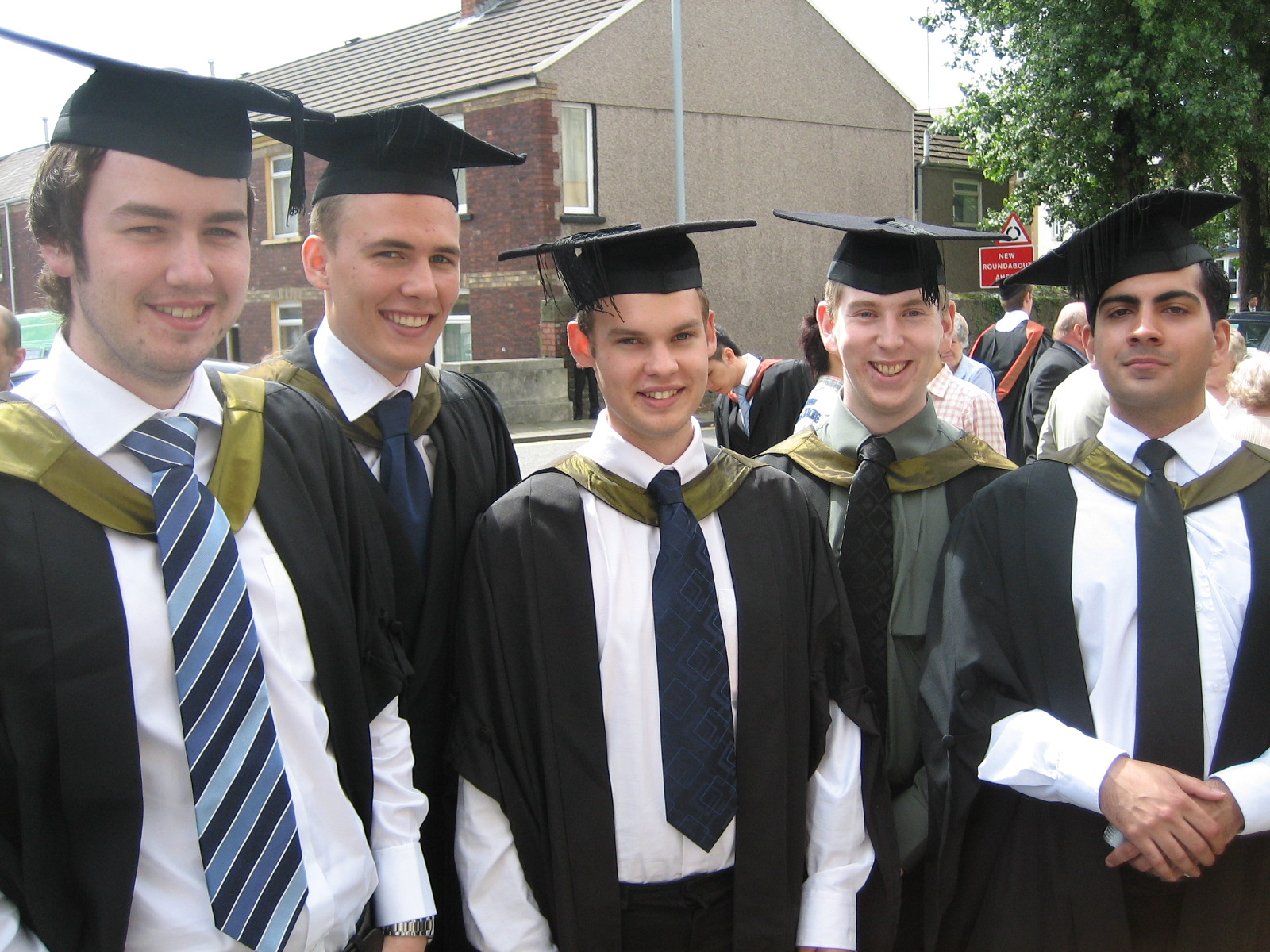
Like any proud father I was happy to have helped my Institution deliver another batch of ICCT graduates. Yesterday, it was gradutaion day and some of the “class of 2007” are pictured here. Good luck chaps and don’t forget me, particulary when you’re rich.