Recent Posts

History of Computing Collection Launch

The British Computer Society (BCS) was founded in 1957 so this is the tail end of its half century celebration year. As part of its local contribution to celebrations, Professor John Tucker took the opportunity of using the Annual General Meeting of the South Wales branch of the BCS to launch his History of Computing Collection (HOCC), which is being developed in conjunction with Library and Information Services (LIS) here at Swansea University. John hopes that this web site (implemented in Open Source CMS Drupal) will develop into a rich archive of the history of computing in, and its impact on, South Wales.

The evening started with an introduction to the HOCC project from Professor Tucker, and was followed by two entertaining talks by welsh IT pioneers Noel Cox and Rod Delamere. The first on the hardware changes seen in large company accountancy since the 1950s, and the second on a programmer’s apprenticeship at Glamorgan College of Technology (now the University of Glamorgan) in the early 1960s. The meeting concluded with an introduction to the HOCC Website itself by its principle developer Steve Williams from LIS.

When the HOCC website launches properly, it is hoped that it will be open for people to record their own recollections of computing. There are certainly plenty of stories to tell: I know a few myself and I’ve been in IT only 29 years! John and colleagues are busy gathering audio testimony from pioneers from the early days, examples of equipment and programs, and other artefacts of computing in Wales which presumably will eventually find their way onto the HOCC site.

On a personal note, the meeting was especially nice in that several retired colleagues from my early days in Electrical Engineering at Swansea turned up and it was great to see them again.

I wish John well on his project and will watch it with interest. Oh, and happy birthday BCS: only two years older than me!
Del.icio.us and Firefox integration

Continuing the saga of the Firefox 3 (FF3) trial, I just installed the beta version of the del.icio.us plugin for Firefox 3 (see previous post). Bookmarks are one of the key new features of have FF3 (see Top 10 Firefox 3 Features (Lifehacker) and Create Your Own Smart Bookmarks on Cybernotes), and I was interested in seeing how they worked with the new plugin. I made a small Jing screencast (sorry no sound) which shows that the del.icio.us plugin works much the same way as it did on FF2 with one small difference. If you bookmark using FF3 bookmarks, a pop-up asks you if you want to also bookmark at del.icio.us too. This might prove either to be useful or annoying depending on how you regard pop-ups! [A similar feature was already present in the Flock browser]

Personally, I rarely use browser-local bookmarks because I move around from machine to machine and rely on the internet to keep my collection in one place and available everywhere. However, perhaps with the advanced bookmarking features added to FF3, the del.icio.us integration and FF3 bookmarking tools may prove to be a winning combination.

Firefox 3 RC1: Plugin Incompatibility


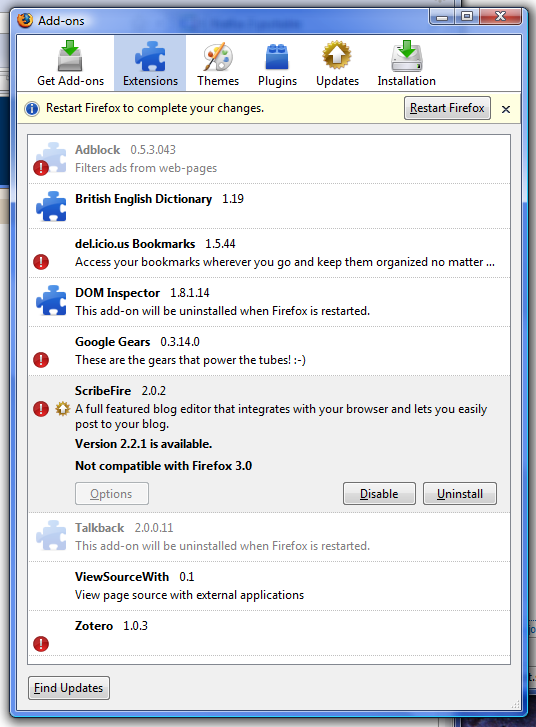
A problem with Firefox 3 is that not all plugins are ready for deployment. The attached image shows my current set (on my laptop I have a couple more). Of particular note are del.icio.us, ScribeFire (for in-browser blogging) and Zotero (bibliographic database).

Google gears is also not yet compatible so support for offline working for Gmail, Google Reader, and Google Docs will not work. I find that I don’t travel enough with my lap top for this to be an issue.

I assume that most plugin providers are waiting on the final release before upgrading their plugins, but if any plugin is important to you, it might be worth holding off installing Firefox 3 for now. If you want to try it, a portable version of Firefox 3 RC1 that runs from a USB memory stick is also available. Alternatively you can run Firefox 2 and 3 on the same machine if you create a new profile for the latter. I wish I’d done that!

Update

I just discovered that there’s a beta version of the del.icio.us plugin for Firefox, so that’s one indispensible tool that I won’t have to live without!

Upgraded to Firefox 3 RC1

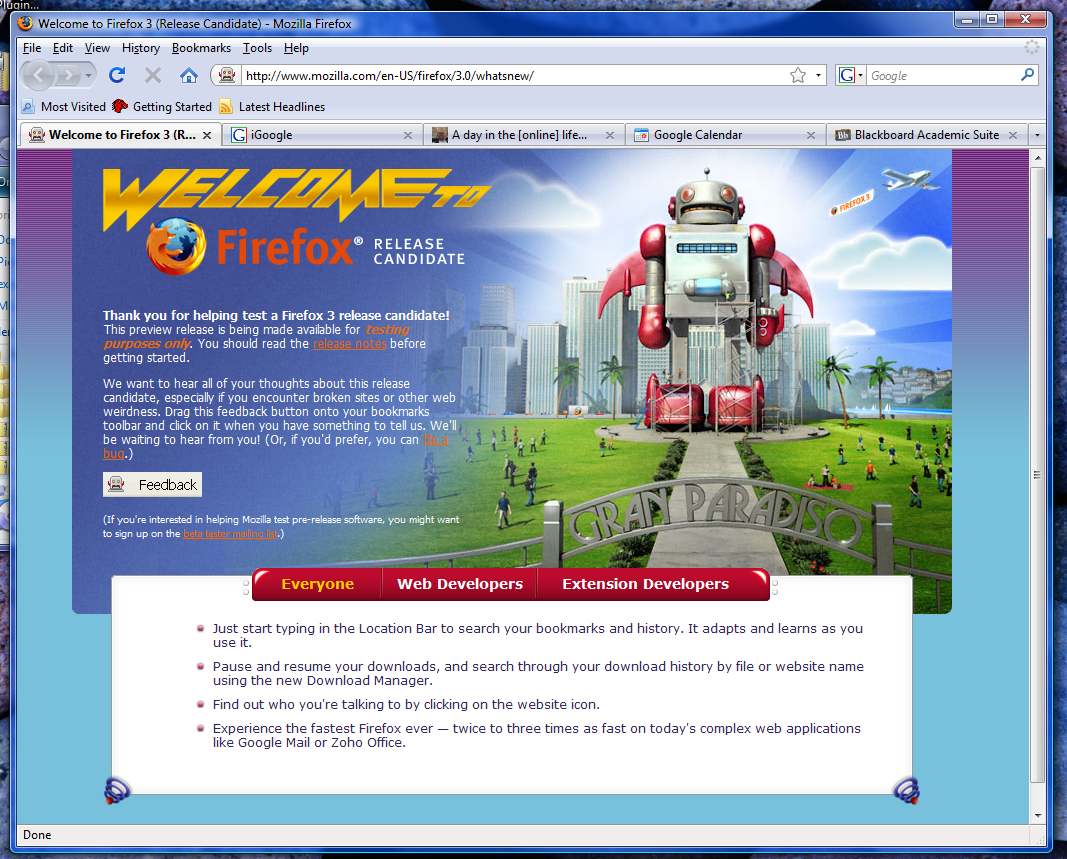
I installed release candidate 1 of Firefox 3 today. I will be giving it a trial run and reporting on any nice features in a future blog. First impression: nice sexy Windows Vista look and friendly welcome page (illustrated). I’ve only installed it on my office desktop so far because my laptop is my main machine and it has a few plug-ins that might not work. So I’m hanging fire there which gives an opportunity for comparison.

Really Simple Surveys with Google Docs

I have just posted an article with demo screencasts on my work blog @the.coalface. The article is concerned with using a new feature of Google Docs Spreadsheets: web form data entry. I intend to use it for project allocation this year, but there are loads of other uses both within education and without.

To get some additional context, read the following articles first.

Although lacking in features provided by subscription sites like SurveyMonkey, it’s a lot simpler to set up and use than most of the alternatives provided by Outlook and SharePoint.

Most of us want data we can analyse in our spreadsheets and that’s exactly what Google Docs Web Forms provides. For a quick and dirty solution, it probably can’t be bettered!

Gone Phishing

On returning to work after the bank holiday I found that my email inbox was full of phishing attempts. Unfortunately for the phishers, I have no accounts with the banks I was being phished by, so it was easy to delete them. But I have to ask, why are phishing scams so random?

Furthermore, why don’t email phishing filters put on a big notice “DODGY” on such emails? They seem to recognise the links as false, so why can’t they be a bit more proactive at marking the messages themselves? It would also be nice to be able to tell your email client which banks you bank and web services you use with so at least they could ignore the false ones.

Blog @ Work

Swansea University, where I work, has quietly established a WordPress blogging system that anyone who has a University login can use to create a blog. This means that I no longer need to worry about providing something myself and should also make introducing blogging to my students a breaze. I created my blog, which I’m calling @the.coalface, and I intend to use it for reflective issues around e-learning, my teaching, research and University life in general. I’ll still continue to use this blog for more generally interesting postings, but it may become less work focussed.

Clyne Guardens in Bloom

It’s May Bank Holiday today and we went for a stroll around Clyne Gardens which is always at its best at this time of year. Azaleas and Rhododendrons are in full bloom and are a riot of reds, purples, yellows and pinks. As usual, more pictures have been posted to Flickr.

Posted by Picasa

Easter Tuesday Constitutional


Today it was Easter Tuesday and we beat the weather and managed a stroll along the coastal path from Mumbles Pier to Langland Bay. Here’s a view along the path towards the coastguard station at Bracelet Bay. More photos on Flickr.

Posted by Picasa

Comments:

iwoods2807 -

Love it!!


Maria H. Andersen -

Not a day goes by where I don't think ... hey, where's the "Learn This" button. The peril of being a futurist! Thanks for the comments!


Jim Stauffer -

Thanks for the link to Maria's pre-print here, Chris. It started me on a journey that linked back to gaming. She references Seth Priebatsch's Game Layer TED talk (http://www.ted.com/talks/seth_priebatsch_the_game_layer_on_top_of_the_world.html) I found a link in a recent comment there to a Game Mechanics Wiki that seems largely unfinished and very promising. http://gamification.org/wiki/Gamification_Encyclopedia


Chris Jobling -

Thanks for the links, Jim!


Chris Jobling -

No problem ... I'm waiting for the learn this button myself now! In the meantime, I might start asking a few Socratic Questions in my courses!