
Following on from Chris Hall’s discovery of Wordle, here’s the Wordle-art tag cloud for my del.icio.us bookmarks. Interestingly this indicates that I’m a typical geek (look at the size of the programming and development tags). Interestingly my courses EG-259 and EG-146 (both on Web Development) feature largely. I’m also apparently keen on the Web and self-improving tutorials! Of course these are only my public tags!
Recent Posts
Bike Ride: NCR 43 Swansea to Pontardawe
 Took a trip up National Cycle Route 43 from Swansea to Pontardawe and back. It was a very windy day and the last 3 miles along Swansea bay was into the wind and a bit of a killer. In other news, my wife Renate got a puncture and had to push her bike home from the Liberty Stadium while I went on ahead to cook the dinner. Puncture repair kit will be next on my shopping list (some would probably say it should have been first).
Pictured (left) is one of the 1000 way-posts that The Royal Bank of Scotland have sponsored on the national cycle network. This  one is about 100 m from the Pontardawe Inn which is also pictured.

Good vibrations
After today’s *lunch and learn* session on Web2.0 at the Chalkface, Paul Latreille inspired me to have another look at Netvibes. I’ve been playing with it on and off since I got home this evening and I’ve launched another version of my life online as a Netvibes public page. See www.netvibes.com/crispyj for more. Come on over and be my friend.

My new public “stalk me” page on Netvibes
Not sure which of Tumblr, Friendfeed and Netvibes that I prefer. But I guess the real question is *which do you* prefer? Perhaps you could leave me a comment to let me know.
Sunday Ride
My wife and I took our new bikes along National Cycle Path number 4 from Brynmill to the Mumbles (Verdi’s) then back to Blackpill and up the Clyne Valley to the Railway Inn. A pint of Three Cliffs Gold then back to the Bay Cycle path and home. Comfortable ride, but it is flat! Gorgeous weather today: hope it stays that way.

Today I Became a Cyclist Again!
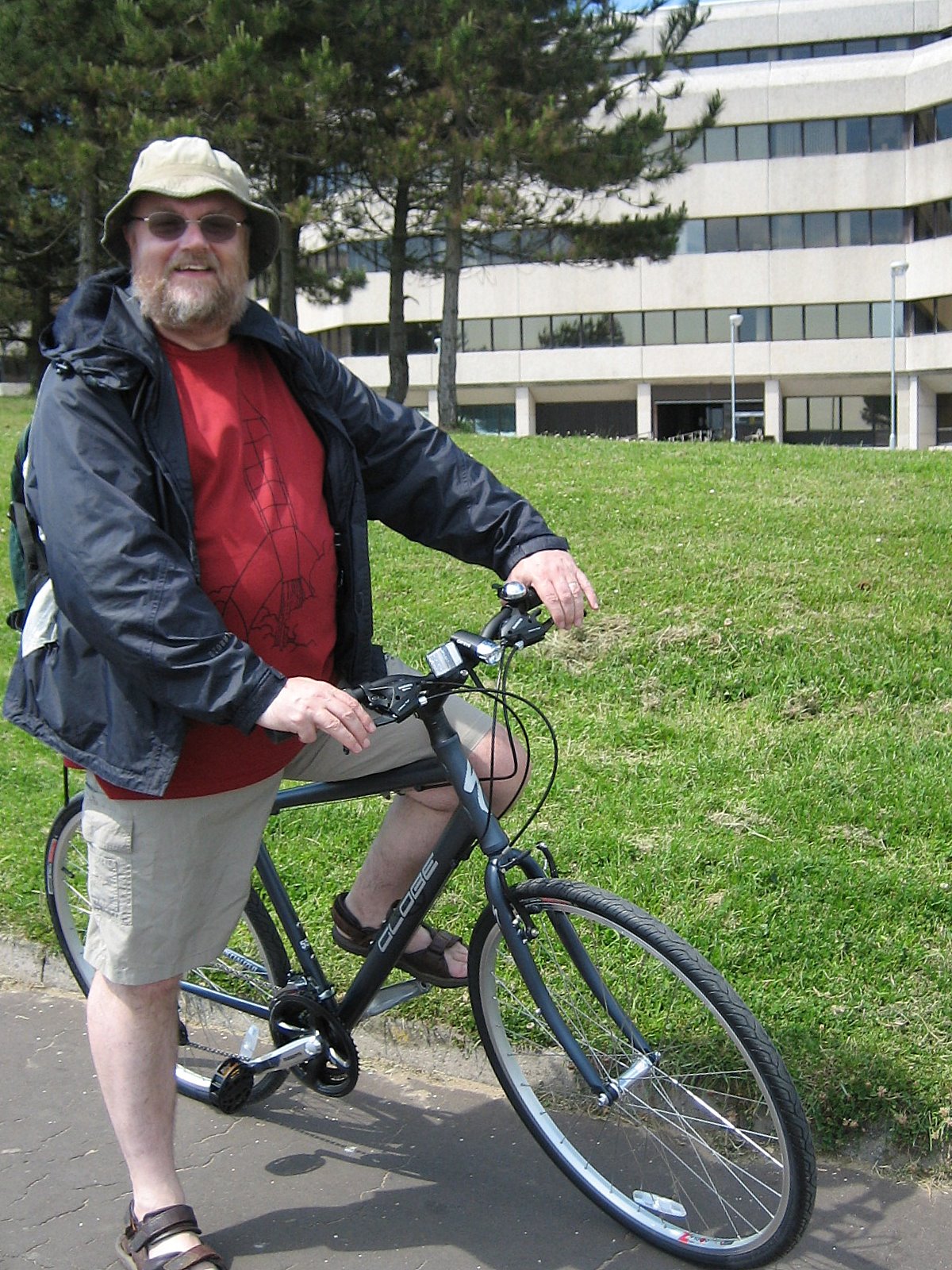 After a long hiatus during which our last pair of bikes have been rusting away in the corner of the garden, my wife and I splashed out on a new set of two wheeled touring machines today. Fitness is low: a short trip to the new Swansea Library in the former Guildhall (now “Civic” Center) nearly killed us! Still the wind was blowing in our faces on the way back! More journeys planned, though we’ll need to build up to the Gower circle!
iTunes: worth another look?
I agree to some extent with Jack Schofield (Apple’s Safari gives Windows users another problem, Guardian Technology Blog, 30th May 2008) when he states that “Apple’s ability to program Windows is a bit of a joke.” There are at least three things wrong with iTunes (especially on Windows Vista):
- the arrogance of the assumption that when you import your media library you want it to translate all your Windows Media Player files into AAC files! This both doubles your storage requirements at a stroke and fills your alternative media player’s libraries with duplicates.
- the complete failure over several release cycles to cope with Vista’s User Access Control and create a usable version that doesn’t break permissions on every update.
- the adoption of the updater as a trojan horse to install the Safari (web browser) for Windows.
The latter was the straw that broke the camel’s back and my reason for uninstalling iTunes a couple of months ago.
However, that said, there is one feature that I have not been able to find in other media software; that is the slick way that podcasts are linked into iTunes and more especially apple’s iPod players. Why can’t other media players do what iTunes does and synchronize the new podcasts to my MP3 player and delete the ones that I’ve listened to on the next update? That feature (which presumably only works on iPods) and the announcement (reported by your correspondent elsewhere) of the availabilty of some selected Open University courses on iTunes U make me think that it may be worth giving iTunes another chance. Perhaps it would be worth getting an iPod too; especially now they do movies (for rental and download)! Plus the iPod touch looks so sexy. Just like an iPhone but without all that redundant phone stuff!
Disruptive Technologies: Digital downloads, iPlayer and Google Friends
In today’s Guardian and Media Guardian there where three articles about how Web technologies are having disruptive effects on traditional media and even (in one case) on one Web 2.0 poster-child technology itself. Here’s a quick summary with links to Guardian On-Line:
- In the Financial Pages Katie Allen discusses the potential effects on sales based on downloading might have on the DVD. In short, it might go the way of the VHS in as little as 10 years!
- In the Media Guardian, Gareth McLean discusses how the BBC iPlayer is transforming television.
- Also in the Media Guardian Jeff Jarvis comments on the Google FriendConnect service and it’s possible impact on Facebook (who controversially refused Google access to Facebook friend lists). Again in summary: by refusing to be open, Facebook may end up being a dead-end.
Stalk Me!
I have a FaceBook account, but find its walled garden too restrictive, and hate having to login to share something. I’m a child of the World Wide Web (man) and all the sites that I want to share with my social network are out there. Inspired by Dean Shareski’s “Lesson #1: Share“, I got myself an account on FriendFeed.com and added all my available accounts.
So now you can stalk me (and become my friend) on the interweb. I also have a Tumblr Blog which acts as a “Life Stream”. It shares some of the same feeds, so there may be some duplication on FriendFeed until I decide which, if either, of these provides the most complete picture of my life on-line. However, the real advantage of these sites is that they take no extra effort. Once you add your sites, they update automagically without any further effort.
Google I/0 2008 Keynote
I have just finished watching the keynote of the Google I/O 2008 conference that took place at 9.30 am Las Vegas time yesterday and was posted on YouTube almost straight away afterwards. The conference is aimed at developers, but there’s a lot that is of general interest and gives insight into Google’s aims for the future. The main message is that Google wants to - make the cloud more accessible; - keep connectivity pervasive; - make the client (browser) more powerful.
Discussed and in some cases demonstrated (in rough order of presentation) were: - Google Gears which allows richer browser experiences by storing and manipulating data locally in the browser. This has been used to implement a search feature in MySpace. - The new Android Mobile Phone SDK which provides WebKit views and allows applications to be built using web browser technology as a User Interface platform. - The Google App Engine which will allow developers to build web applications that will deploy and run on Google’s “cloud” platform. - The Google Data (GData) and Google AJAX Search APIs which allow the development of application mashups using read-write access to Google services (GMail, Calendar, Google Docs, Picasa, etc.) and read-only access to services like Google Maps, Google News, Google Serach, YouTube, etc. - Release Candidate 1.5 of the Google Web Toolkit which allows developers to build rich internet applications in Java - OpenID (single sign on for the web), OAuth (universal authentication) and Open Social (social network development) which will help interesting Web2.0 applications to be developed.
The technical sessions will (or already have) go into these in more detail and will no doubt be made available on YouTube in the Google Developers channel over the next few days. The impression that you get is that Google is really committed to Open Source and the Web. Downstream, I’m sure that they see dollars and cents in these technologies, but for now it seems that they are keen to get developers developing browser-based web applications.
If this blog entry has sparked your interest in these Google Code projects (or you are one of my Project students!), I suggest that you visit the Google Code site to gain an insight into what Google is doing in and for the Open Source and Web developer communities.
History of Electrical Engineering on the Web
One of the highlight’s of yesterday’s History of Computing Collection launch was Steve William’s presentation of the history of the University’s web site which he gathered from the Way Back Machine at the Internet Archive. As I developed the Department of Electrical and Electronic Engineering’s web site from 1996 through to around 2006 I thought I’d visit the Way Back Machine to look at how that web site http://www-ee.swan.ac.uk/ developed. I will probably have to write down the technical details one day, but for now, here are the key development stages:
-
 In January 1998 the site looked like this. You’ll possibly note that the home page isn’t even about the department! Instead it contains a link to the actual home page.
 I clearly didn’t know much about Information Architecture then. However to ensure that the site was consistently formatted, I was using a templating tool called HTP (which is still available from sourceforge).
-
 In January 1999 the site was formatted to a corporate style using table layout and had a guestbook!
-
By January 2000 we had style sheets (note that the links turn red
 on hover) and custom bullets. The University’s site at this time was using images of text in order to use the Palatino font that the consultants had decided that its corporate branding needed! I was using Times
 Roman Italic! The three column layout was done with tables.
-
From 2000 to 2005 the web site design stayed pretty constant. The only thing that changed behind the scenes were that I moved from HTP to the Perl Template Toolkit for the site templating.
-
 In 2006, the Department finally turned off www-ee.swan.ac.uk and the engineering web site was established. This is run inside the University’s Content Management System (CMS). That site is undergoing a relaunch this summer.


I no longer maintain a large web site, but if I did, I’d use a CMS like Drupal. For small “vanity sites” or group home pages, I’d recommend using a wiki: my homepage these days is a Dokuwiki wiki.
Comments:

AJCann -
Thanks for your valuable input Chris, much appreciated that you chose to share with the wider academic community.

It was my pleasure. Hope to meet you in person one of these days!