Recent Posts

Swansea 2020 and Twitter

On Monday I attended the launch and first public lecture of the Swansea University's centenary celebration Swansea 2020 and the launch of the Centenary Essays site.

At the lecture, Sam Blaxland, the historian appointed by the University to write the history of the University's first 100 years, gave us an excellent overview of the highlights of that centenary and how he went about writing the book which will be released in June.

Twitter 1920?

On Wednesday, in the lead up to the LTHChat (wakelet), my Twitter colleague Simon Rae asked me how I thought the original academics who welcomed the first 80 odd students to enrol in 1920 might have viewed Twitter:

https://twitter.com/simonrae/status/1220073803126116358

To which I replied:

https://twitter.com/cpjobling/status/1220074148074020865

This led to this interesting conversation between Simon and Sam (tweeting as @Swansea2020) which I include in full:

https://twitter.com/simonrae/status/1220089291449290753

https://twitter.com/Swansea2020/status/1220258605905207296

https://twitter.com/simonrae/status/1220373883666280450

https://twitter.com/Swansea2020/status/1220385428940959746

https://twitter.com/simonrae/status/1220440801127342084

https://twitter.com/Swansea2020/status/1220442950653698061

https://twitter.com/simonrae/status/1220733403882041344

Oral History and Podcasting

Sam's approach to writing his history included the use of oral history and he has interviewed hundreds of people over the three-year project. He has adapted these skills further by hosting the University's Exploring Global Problems Podcast an excellent series that is worth a listen!

Time to turn out the lights

If Johnson wins today will the last person to leave Britain please turn out the Lights. Mashup based on Sun splash from polling day 1992

I am old enough to remember the Sun newspaper's 1992 splash "If Kinnock wins today will the last person to leave Britain please turn out the lights" published on polling day for the 1992 General election. They repeated the same trick, and the same headline, with Ed Milliband in 2015.

On Friday 13th 2019, having been shocked at yesterday's exit poll predicting the largest Conservative party majority since 1983, and being dismayed on waking this morning find out that it was true, I think that I will soon be leaving Britain and turning out the lights.

Since June 2016, Britain's have sleep-walked towards the disaster that is Brexit. Resistance has been futile. We have been assimilated. But, I have an exit plan. I am married to a German. A European citizen who has lived in Wales for 34 years, paid her taxes, contributed to the local economy, been a good citizen. Who has been made, like many EU citizens settled here, to feel unwelcome and has had no say any of this! She's been aching to go home for three years. In the meantime, I've been hanging on and hoping that the nightmare would end, that sense would prevail, that the nation would realize that revoking article 50 was actually the only sensible way out of the mess we'd got ourselves into!

Instead, Britain has voted for Boris Johnson. The joke candidate. The guy who hides in a fridge to avoid an unscripted interview. It's Boris's face that should have been on that light bulb. And now it is.

I am lucky. I can migrate to Germany and be welcomed as mywife's partner. Five years from now I can be a German citizen, and an EU citizen again.

I will enjoy my retirement. Chewing the fat at an ex-pat Stammtisch in my local pub in, in Berlin, that city that used to be physically divided by a wall. I'll be able to watch as Britain's inevitable decline is described by bemused eyebrow-raised moderators on Tagesschau. As Scotland becomes independent; as Ireland reunites; and as Wales goes down the toilet, a forgotten, neglected, vassal state of a nationalist, nasty England.

I thought my retirement and emigration was a few years away yet. Today, it looks like it's only a matter of weeks.

Declaration of Digital Independence

See also: Social Media Strike! — FAQ about the project to decentralize social media — Resources

Humanity has been contemptuously used by vast digital empires. Thus it is now necessary to replace these empires with decentralized networks of independent individuals, as in the first decades of the Internet. As our participation has been voluntary, no one doubts our right to take this step. But if we are to persuade as many people as possible to join together and make reformed networks possible, we should declare our reasons for wanting to replace the old.

We declare that we have unalienable digital rights, rights that define how information that we individually own may or may not be treated by others, and that among these rights are free speech, privacy, and security. Since the proprietary, centralized architecture of the Internet at present has induced most of us to abandon these rights, however reluctantly or cynically, we ought to demand a new system that respects them properly. The difficulty and divisiveness of wholesale reform means that this task is not to be undertaken lightly. For years we have approved of and even celebrated enterprise as it has profited from our communication and labour without compensation to us. But it has become abundantly clear more recently that a callous, secretive, controlling, and exploitative animus guides the centralized networks of the Internet and the corporations behind them.

The long train of abuses we have suffered makes it our right, even our duty, to replace the old networks. To show what train of abuses we have suffered at the hands of these giant corporations, let these facts be submitted to a candid world.


They have practised in-house moderation in keeping with their executives’ notions of what will maximize profit, rather than allowing moderation to be performed more democratically and by random members of the community.

They have banned, shadow-banned, throttled, and demonetized both users and content based on political considerations, exercising their enormous corporate power to influence elections globally.

They have adopted algorithms for user feeds that highlight the most controversial content, making civic discussion more emotional and irrational and making it possible for foreign powers to exercise an unmerited influence on elections globally.

They have required agreement to terms of service that are impossible for ordinary users to understand, and which are objectionably vague in ways that permit them to legally defend their exploitative practices.

They have marketed private data to advertisers in ways that no one would specifically assent to.

They have failed to provide clear ways to opt out of such marketing schemes.

They have subjected users to such terms and surveillance even when users pay them for products and services.

They have data-mined user content and behaviour in sophisticated and disturbing ways, learning sometimes more about their users than their users know about themselves; they have profited from this hidden but personal information.

They have avoided using strong, end-to-end encryption when users have a right to expect total privacy, in order to retain access to user data.

They have amassed stunning quantities of user data while failing to follow sound information security practices, such as encryption; they have inadvertently or deliberately opened that data to both illegal attacks and government surveillance.

They have unfairly blocked accounts, posts, and means of funding on political or religious grounds, preferring the loyalty of some users over others.

They have sometimes been too ready to cooperate with despotic governments that both control information and surveil their people.

They have failed to provide adequate and desirable options that users may use to guide their own experience of their services, preferring to manipulate users for profit.

They have failed to provide users adequate tools for searching their own content, forcing users rather to employ interfaces insultingly inadequate for the purpose.

They have exploited users and volunteers who freely contribute data to their sites, by making such data available to others only via paid application program interfaces and privacy-violating terms of service, failing to make such freely-contributed data free and open source, and disallowing users to anonymize their data and opt out easily.

They have failed to provide adequate tools, and sometimes any tools, to export user data in a common data standard.

They have created artificial silos for their own profit; they have failed to provide means to incorporate similar content, served from elsewhere, as part of their interface, forcing users to stay within their networks and cutting them off from family, friends, and associates who use other networks.

They have profited from the content and activity of users, often without sharing any of these profits with the users.

They have treated users arrogantly as a fungible resource to be exploited and controlled rather than being treated respectfully, as free, independent, and diverse partners.


We have begged and pleaded, complained, and resorted to the law. The executives of the corporations must be familiar with these common complaints, but they acknowledge them publicly only rarely and grudgingly. The ill-treatment continues, showing that most of such executives are not fit stewards of the public trust.

The most reliable guarantee of our privacy, security, and free speech is not in the form of any enterprise, organization, or government, but instead in the free agreement among free individuals to use common standards and protocols. The vast power wielded by social networks of the early 21st century, putting our digital rights in serious jeopardy, demonstrates that we must engineer new—but old-fashioned—decentralized networks that make such clearly dangerous concentrations of power impossible.

Therefore, we declare our support for the following principles.


Principles of Decentralized Social Networks

  1. We free individuals should be able to publish our data freely, without having to answer to any corporation.
  2. We declare that we legally own our own data; we possess both legal and moral rights to control our own data.
  3. Posts that appear on social networks should be able to be served, like email and blogs, from many independent services that we individually control, rather than from databases that corporations exclusively control or from any central repository.
  4. Just as no one has the right to eavesdrop on private conversations in homes without extraordinarily good reasons, so also the privacy rights of users must be preserved against criminal, corporate, and governmental monitoring; therefore, for private content, the protocols must support strong, end-to-end encryption and other good privacy practices.
  5. As is the case with the Internet domain name system, lists of available user feeds should be restricted by technical standards and protocols only, never according to user identity or content.
  6. Social media applications should make available data input by the user, at the user’s sole discretion, to be distributed by all other publishers according to common, global standards and protocols, just as are email and blogs, with no publisher being privileged by the network above another. Applications with idiosyncratic standards violate their users’ digital rights.
  7. Accordingly, social media applications should aggregate posts from multiple, independent data sources as determined by the user, and in an order determined by the user’s preferences.
  8. No corporation, or small group of corporations, should control the standards and protocols of decentralized networks, nor should there be a single brand, owner, proprietary software, or Internet location associated with them, as that would constitute centralization.
  9. Users should expect to be able to participate in the new networks and to enjoy the rights above enumerated, without special technical skills. They should have very easy-to-use control over privacy, both fine- and coarse-grained, with the most private messages encrypted automatically, and using tools for controlling feeds and search results that are easy for non-technical people to use.

We hold that to embrace these principles is to return to the sounder and better practices of the earlier Internet and which were, after all, the foundation for the brilliant rise of the Internet. Anyone who opposes these principles opposes the Internet itself. Thus we pledge to code, design, and participate in newer and better networks that follow these principles, and to eschew the older, controlling, and soon to be outmoded networks.

We, therefore, the undersigned people of the Internet, do solemnly publish and declare that we will do all we can to create decentralized social networks; that as many of us as possible should distribute, discuss, and sign their names to this document; that we endorse the preceding statement of principles of decentralization; that we will judge social media companies by these principles; that we will demonstrate our solidarity to the cause by abandoning abusive networks if necessary; and that we, both users and developers, will advance the cause of a more decentralized Internet.

Please sign this petition if you agree!

Sign on Change.org.

This post is adapted from Larry Sanger, Declaration of Digital Independence, Version 1.3. Accessed July 3rd, 2019.

Creative Commons License

This work is licensed under a Creative Commons Attribution-ShareAlike 4.0 International License.

Microsoft Whiteboard for iOS

Microsoft has recently released the iOS version of its new Whiteboard app and I recorded this quick video to give my first impressions. There is certainly already sufficient functionality here for me to want to use it in my classes.

https://youtu.be/23XokK95DAo

The features that I like are:

  • Infinite size canvas -- like in OneNote.
  • Ruler for drawing straight lines at various angles.
  • Ink to shape.
  • Share to OneNote (as an image).
  • Share whiteboard with collaborators for brainstorming in meetings.
  • All whiteboards are stored in the cloud.

Features that it has that I didn't demonstrate

  • Add images
  • Sticky notes
  • Ink to table

There are some differences between the Windows and iOS versions but I imagine that they will become more compatible in time. I would also hope to see some of the additional drawing features supported by OneNote being added as the product develops.

The iOS version follows on from the Windows 10 version that has been available for a while. There is a preview version for the web.

If you want to give it a try, visit whiteboard.microsoft.com. You need a free Microsoft or an Office 365 account to use it.

25 Years of Ed Tech

In honour of the silver jubilee of the Association for Learning Technology (ALT), ALT Conference 2018 Co-Chair Martin Weller has been compiling a personal history of the development of Educational Technology (Ed Tech) covering the years 1993 to the present. The final episode, 2018 Critical Ed Tech was published yesterday. Ranging from AI, through the web, eLearning, MOOCs, back to AI and on to blockchain -- like Lasers in the 60s, surely a technology looking for an application -- it's an entertaining look at all the disrupting technologies that somehow failed to disrupt education. And a sobering thought that I was there to uncritically early-adopt a lot of it too!

You can read the whole lot by visiting the category 25yearsedtech on Martin's Ed Techie blog.

Highly Recommended.

Minisurvey on VLE use

Last month I started this sequence of posts on using OneNote Class Notebook as a VLE by posting a simple 3-question survey using Microsoft forms. There have been four submissions (one was mine), so please have a go if you want to improve these results.

Here are the results.

1. Do you use a VLE?

100% of those who took the survey said yes!

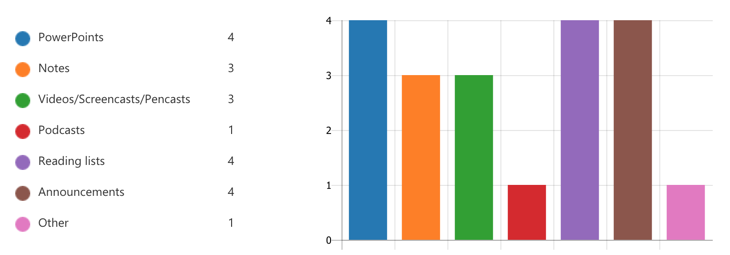
2. What kinds of content do you deliver through your VLE?

[caption id="attachment_2290" align="alignnone" width="730"]q2 Responses to Q2[/caption]

No surprises here I guess. For most staff (and probably students too), the VLE is primarily seen as a content management system. Everyone uses PowerPoint and notes. It's pleasing to see videos, screencasts and pencasts being used. One respondent uses podcasts. Reading lists and announcements are used by all. The respondent who selected "other" uses Diigo feeds and embedded learning objects created in Xerte and Articulate.

The good news is that OneNote class notebook can support most of these use cases with file attachments. Office attachments will open in the native app. Some media types, audio and video, can be embedded; YouTube videos can be automatically inserted from the YouTube share link. Other media types may need to be linked to.

It's worth noting that OneNote pages support sophisticated text markup (with excellent accessibility features and the unique learning tools), and there is digital ink support (for handwritten annotations) which rivals the HTML editors provided by most VLEs.

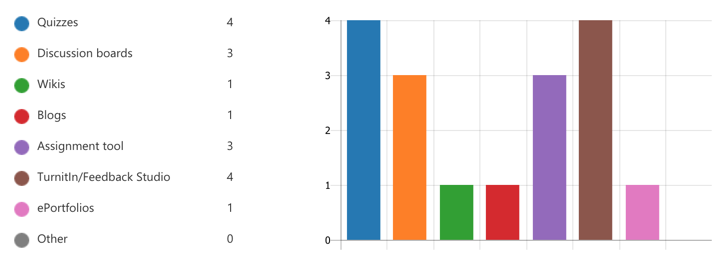
3. What "interactive" features of your VLE do you use in your teaching?

[caption id="attachment_2291" align="alignnone" width="728"]q3 Responses to Q3[/caption]

OneNote Class notebook on its own provides support for the equivalent of wikis (collaborative documents), Blogs, and ePortfolios. You would have to combine it with Microsoft Teams to have useful discussion boards (including video discussions powered by FlipGrid) and assignment tools (including grading rubrics). You can create very simple embedded quizzes and surveys using Microsoft Forms, but you'd need to link to your VLE or a third-party tool for more fully featured quizzes.

Having set the scene, in the next article in this series, I will describe the OneNote class notebook and how I use it!

OneNote Class Notebook - Your Next VLE?

At last year's SALT conference (#SUSALT17), I ran a session on using the OneNote Class Notebook (ONCN) with the same title as this post. The title, of course, was meant to be provocative, but having used the OneNote Class Notebook for three years now, I believe that it has great potential, is getting a lot of love from Microsoft, and deserves to be more widely known.

In this series of posts, I will attempt to open up my 2017 talk to a wider audience and bring in a discussion of Teams for Education, demonstrate the new ONCN plugin for Blackboard, and showcase my own use of ONCN in teaching.

To start things off, I'll repeat what I did in my talk and start with a survey.

Please feel free to complete it. I'll report the findings in a few days time.

Summer To Do List

It's graduation next week, the official end of the University year and the start of the summer battery recharge. Inspired by a comment from my friend and colleague Chris Hall made at yesterday's #SUSALT18 Conference, I thought that it was time to reactivate my blog with a few thoughts on what I want to achieve over the summer.

So here, in no particular order, are the things on my todo list.

  • Annual module review of my own modules.
  • Final Board of Studies meeting
  • Away day for programme review (planning to use the ABC LD Toolkit 2018 from UCL)
  • Learn how to use the Rohde-Schwartz instrumentation in our labs
  • Play with National Instruments micro DAC
  • Produce a how-to for embedding OneNote class notebooks into Blackboard
  • Survey of my college's Blackboard sites
  • Develop guidance for achieving the minimum standard
  • Help the University to define the data requirements for Annual Programme Review
  • Prepare my Senior Fellow HEA application
  • Train as an IET Accreditor
  • Properly flip my semester 2 courses.
  • Finish Laurillard's Teaching as a Design Science and finally read Talbert's book on Flipped Learning and Nilson's on Specifications grading.
  • Continue to advocate for wider use of Microsoft Teams for Committees, Work Groups, Communities of Practice, Courses and Students within my University.
  • Go on holiday
  • ALT Conference

Some of these will be part of my CPD, some may be of interest to my readers. However, I make no promise that any will become the subject of a future blog post.

One reason that I haven't felt the need to Blog for a while is that I have been keeping a (nearly daily) Journal in TiddlyWiki. It's live, hosted in GitHub pages and reachable at journal.cpjobling.net.

#SUSALT18 - Wakelet

Cross-posted from the LTEC Blog.

For those who couldn't make the 10th SALT conference held at the Bay Campus, here is a Wakelet I made of the tweets from the event.

If you want to learn more about Wakelets and how to make them, the new way to curate social media posts and create stories using @wakelet by Sue Beckingham (@suebecks) is an excellent introduction.

Comments:

Diwrnod 4 #SU5DoT: Hashnodau – su5dot -

[…] a rhannu trydariadau â hashnod ar ôl y digwyddiad. Golloch chi gynhadledd SALT y llynedd? Gallwch ddarllen y trydariadau o […]


Fourth day of #SU5DoT: Hashtags – su5dot -

[…] To livetweet an event means to tweet about it while you’re actually participating in it. Conferences or seminar presentations are often livetweeted. This may be done in an official capacity, with organisers inviting participants to livetweet the papers. There is often a pre-agreed ‘official’ hashtag to use. The hashtag can be used before, during and after the event. Following the hashtag can be a good way to find out who’s going to be there, what the papers were about, and any follow-up questions. Hashtagged tweets can be curated and shared after the event. Did you miss last year’s SALT Conference? You can still catch up on the tweets! […]