Posts from 2010

Wave bye bye

Although I missed the original announcement, I am indebted to Jane Hart who shared the announcement Update on Google Wave (posted by Urs Hölze on the Official Google Blog) of Google’s decision to cease development of Google Wave:

We were equally jazzed about Google Wave internally, even though we weren’t quite sure how users would respond to this radically different kind of communication. The use cases we’ve seen show the power of this technology: sharing images and other media in real time; improving spell-checking by understanding not just an individual word, but also the context of each word; and enabling third-party developers to build new tools like consumer gadgets for travel, or robots to check code.

But despite these wins, and numerous loyal fans, Wave has not seen the user adoption we would have liked. We don’t plan to continue developing Wave as a standalone product, but we will maintain the site at least through the end of the year and extend the technology for use in other Google projects. The central parts of the code, as well as the protocols that have driven many of Wave’s innovations, like drag-and-drop and character-by-character live typing, are already available as open source, so customers and partners can continue the innovation we began. In addition, we will work on tools so that users can easily “liberate” their content from Wave.

(Emphasis mine).

I was enthusiastic about the potential at the time of the first developer preview at Google I/O 2009. During the beta test period, I was the first person at my University to get a Wave invite, and the guest passes went like hotcakes. (I was the most popular man on the intranet for a couple of days … it was like Cheers, everyone knew my name!)

But our experience probably matched most … wow that’s cool, we can see each other’s edits … followed quite quickly by what can we really do with it?

As an educationalist, I was also enthusiastic about the educational possibilities. With my new account, I subscribed to an open thread (actually started by Blackboard I just realise) on using the wave in education. I also started a similar thread locally. Visiting the open thread, you get an inkling about what might be wrong with the Wave. People seem to use it as a glorified chat client or a forum on steroids. They don’t seem to use it in the disciplined way needed to do real work with it. Indeed this may be a reason why a recent suggestion that we use Wave for a collaborative document creation project fell on deaf ears.

Wave is an excellent example of what can be done with HTML and JavaScript. The conversational tools are great for a back channel: has better context than Twitter for example, but it’s the conversation rather than the work that seems to dominate in the Wave client as it was released. There are strong hints in the Google announcement that Wave technology will be used in other Google services, but it looks like Wave as an app, like a mayfly, has had it’s day in the sun.

As you’d expect, there were immediate reactions to Google’s announcement from the Blogosphere before I wrote this post:

I’ll add more links as I see more reaction. For now, follow the links to Google’s Real-time Search for the latest reaction from the Blogosphere and Twitter. It’s not in the top ten list of trending topics on Twitter yet, but it can only be a matter of time!

**Update**

If you were wondering what the wave was and how it should have been used, Gina Trapani wrote the book The Complete Guide to Google Wave with Adam Pash that’s (still) available to read on-line.

Interesting side note, comments from US were being posted at 2.30 and 4.00 am local time. Don’t these guys sleep?
Podcast of the Week #2: Tech Weekly

It’s actually a fortnight since the last one but … this week’s Podcast of the Week is The Guardian’s excellent Tech Weekly podcast. Every Wednesday, regular host Aleks Krotoski along with regular contributors Guardian Technology Editor Charles Arthur and Digital Media Reporter Jemima Kiss, discuss the big technology news items of the week.

Since the demise of The Guardian’s Thursday Technology supplement, the podcast is the quickest way to keep up to date. Highlights this week include a discussion of emerging trends in the Mobile Internet, the new Amazon Kindle and the ban on Blackberrys in the UAE.

Academic colleagues may be interested to learn that Mendeley will be discussed next week.

The Guardian Online has excellent technology coverage online. The launch point for exploration is www.guardian.co.uk/technology. If you’re on the move, The Guardian’s mobile offering (m.guardian.co.uk) is not bad either!

Blackboard 9.1 Tips - #1 Campus Pack

Learning Objects Campus Pack, used to provide for blogs, wikis and podcasts in Swansea University’s VLE, was updated at the same time as Blackboard. If you have one or more Learning Objects blog(s), wiki(s) or podcast(s) in your Blackboard (learning portal) module sites, they will be upgraded the first time you or your students visit them.

If you have a large number of these installed in a module site, as I have for some of my modules, you may want to do the upgrade before your course is opened for new enrolments. That way, you will avoid confusion for your students and any colleagues you may be sharing a module site with.

Blackboard flag day

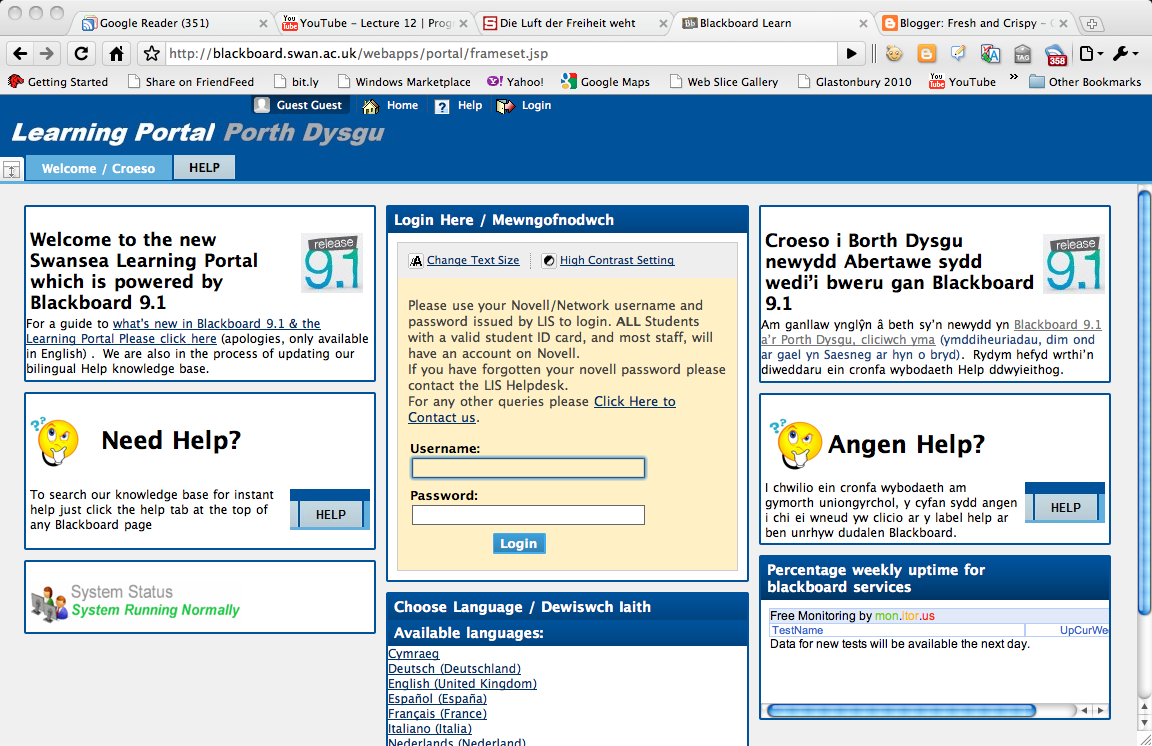
Today is the day when Blackboard 9.1 was rolled out at Swansea University as the new Learning Portal. I haven’t logged in to check my courses yet, but I’m sure they’ll be fine.

Clive and his team promised to deliver the update on July 30th, and that’s what they’ve done.

I know a lot of planing and work has gone into this and it’s been done with minimum fuss and negative impact.

Great job guys!

Great Teaching

I love this video from the first lecture of CS 106A Programming Methodology (Recorded in Fall 2008). Apart from the enthusiasm of the lecturer Mehran Sahami, which is infectious, it’s a great source of inspiration for learning and teaching:

- Grading without numbers - The Stanford Honour Code (approach to Plagiarism) - Use of undergraduates for peer/mentor support (even grading!) - Use of sugary snacks as rewards for contribution - Use of continuous assessment with later work given more marks to encourage work to the end - Midterm tests - Personalized feedback via “interactive marking” - 2 Free days for late submission of coursework – avoids extensions.

Not sure how we could do it all … but there must some of this which has to be worth trying. The video embedded below is hosted on YouTube and can be downloaded and redistributed under a Creative Commons (Attribution-Noncommercial-No Derivative Works) license.

There is a YouTube channel for the whole course.

The follow-on course, CS106B Programming Abstractions (See YouTube channel for CS106B), was also recorded in the 2008 academic year. The lecturer that year, Julie Zelenski, is also a great performer, but the course is also worth noting because it’s the first example I’ve seen where there’s a Facebook link page embedded in the course web site.

Mathemagic (part the first)

This code snippet on calculating the first n Primes using the Python programming language fell into my RSS feed this morning. Very nice I thought, but then it occurred to me, what would be really fast would be to ask the internet. Or more specifically WolframAlpha. So I did: http://www.wolframalpha.com/input/?i=primes+less+than+1,000,000,000.

The first 20 of 50,847,324 prime numbers less that 109 are displayed in the internet equivalent of a blink of an eye.

One assumes that Mathematica is doing the sums in an efficient way so you get the benefit of expert algorithm knowledge *and* get right to the answer just by asking the obvious question “primes less than 10,000,000,0000″.

You also get to know how many of them there are, and if you want, you get a PDF listing them that you can use to wallpaper your room.

Prime numbers are very interesting. Wikipedia has a fairly detailed introduction. Asking WolframAlpha about “primes” gives you some basic information and examples of useful queries and there’s loads of information about Prime Numbers at the Mathematica Mathworld website. Marcus du Sautoy talks about prime numbers (the “Atoms of Mathematics”) in this video. There are also a number of ways of testing for finding prime numbers using Prime Factorization and many efficient, and less efficient, ways of doing Prime Factorization with a computer.

Incidentally, is the Python algorithm really the fastest way? What does *Mathematica* do? Answers, with proofs, in the comments!

OSCON 2010

The O’Reilly Open Source Convention (OSCON 2010) took place last week in Portland Oregon. Videos of the talks are being published on YouTube and Blip.TV. Taken with the convention site, the various related blog postings and twitter feed, there’s lots of useful information.

What stood out for me in the video feed was Daniel Recordon’s talk “Today’s Lamp Stack” which describes how Facebook’s has been implemented on the LAMP stack. It’s a talk that will be useful as a learning resource for my course on Web Applications Technology.

For ease of access, I include the embeddable version here.

[blip.tv http://blip.tv/play/AYHwpRwC]
The learning message is that there’s a lot more to hosting a big site like Facebook than Linux, Apache, MySQL and PHP!

Podcast of the Week #1: E-Learning Stuff

I read a lot of blogs and I listen to a lot of podcasts, so I thought I’d use this blog to tell you about some of my favourites. Here’s the first of an occasional series of recommendations: It’s e-Learning Stuff and the associated e-Learning Stuff podcast from James Clay, ILT & Learning Resources Manager at Gloucestershire College, and 2009 winner of the ALT Learning Technologist of the Year.

I am an early adopter and self-confessed geek. I love new technologies and often try to find ways to incorporate them into my teaching (and personal learning). But as an *educator* rather than a *learning technologist*, the bottom line for me is that I want my students to gain value from my experiments with e-learning technology. The technology should not be an end in itself. As such, I’m only on the periphery of the e-learning technology community. A guest, rather than a fully paid up member, if you like.

I have a digital identity and a personal learning environment that extends across this blog and my Facebook, Twitter, Posterous and FriendFeed accounts. I aggregate my Google shared items, Buzz, delicious account, Flickr, YouTube, SlideShare and Prezi to my FriendFeed. But despite all this, I still spend a frighteningly large amount of time in the institutional Virtual Learning Environment (Blackboard in our case). I tend to bring resources *into* the VLE on the basis that that’s were I assume students will be coming to find them, rather than trying to work outside it.

To the e-learning community, the VLE is like bronze-age technology that should have been made redundant by the dawn of the machine-gun age. But if most HE institutions are anything like mine, bronze-age weaponry is well in advance of the stone-age (should that be *chalk*-age) technologies that most of my colleagues are wedded to. It’s therefore refreshing to find learning technologists who are as pragmatic as James is. Sure, he likes his toys, but he also knows where the real world is at. His blog, especially his posts on 100 ways to use a VLE, is inspiring, and his podcast, usually consisting of a discussion with colleagues from the FE community mixed with the occasional recorded conference keynote, is genuinely interesting.

Recent highlights from the podcast include:

- I Haz iPad Too - Engaging with the VLE - The VLE Lives - Keep Calm and Carry On - The VLE is Dead

You can, or course, subscribe to the podcast at iTunes.