Posts from 2010

This week ...

… I’ve been mostly

  • developing a new version of my project allocation tool in Drupal (permissions, CCK and views,.. oh my!);
  • re-launching the annual research project selection round in Blackboard; and
  • re-launching Social Engineering as a self-hosted Elgg site.

In the meantime, last-year’s research projects have been winding down (submission deadline was yesterday and vivas are in two-weeks), and we’ve been winding up to asking colleagues for the 500 or so new projects we are going to need for 2010-2011.

A Beginner's Guide to Social Engineering

Today I presented a “Lunch and Learn Session” to colleagues at our Staff Development Unit. Here are the slides which are hosted at Google Docs.

[googleapps domain="docs" dir="present/embed" query="id=ajggj8h93vqb_20130gsvxt3fw" width="410" height="342" /]

The creation of a Ning network was a highlight of the session, and unfortunately that bit is not present here, but the *intro* and *outro* may nevertheless be of some interest.

There is also a SlideShare version which includes some extra video which I may get around to narrating and including a screencast demo of Ning site creation. Watch this space!

Digital Economy Bill

The Digital Economy Bill was pushed through parliament last night despite the attempts of MPs on the Labour and Liberal Democrat benches to force it to be delayed for proper scrutiny until after the next election.

It’s apparently not a big issue in the electoral coverage and at the time of posting there had only been four reactions in the *blogs* of mainstream media:

- Charles Arthur, Guardian Technology Editor, live blogged the whole debate and then summarised in “Digital economy bill rushed through wash-up in late night session“. - The BBC News site posted initial reaction “Anger about ‘Digital Stitch-Up’” which includes recording of the whole 264 minute debate. - Mike Butcher of the Telegraph posted The Digital Economy Bill: a nightmare of unintended consequences. - James Graham in *Comment is Free* on the Guardian reacts to the debate with an opinion piece Digital economy bill exposed broken system that calls for a reform of Parliament and a vote for the Liberal Democrats (hardly non-partisan then!) We will have to wait until Friday’s papers to read more considered coverage of the implications of this, but I fear that Government has legislated in haste, and we will have to repent at leisure.

More reactions from Google’s Realtime Search, the excellent Guardian Web Technology site. My MP didn’t attent for the debate or the vote (even though I emailed him about it) and there was a very distinct difference between the social media’s response to this issue and that of our representative democracy.

It's its not it's

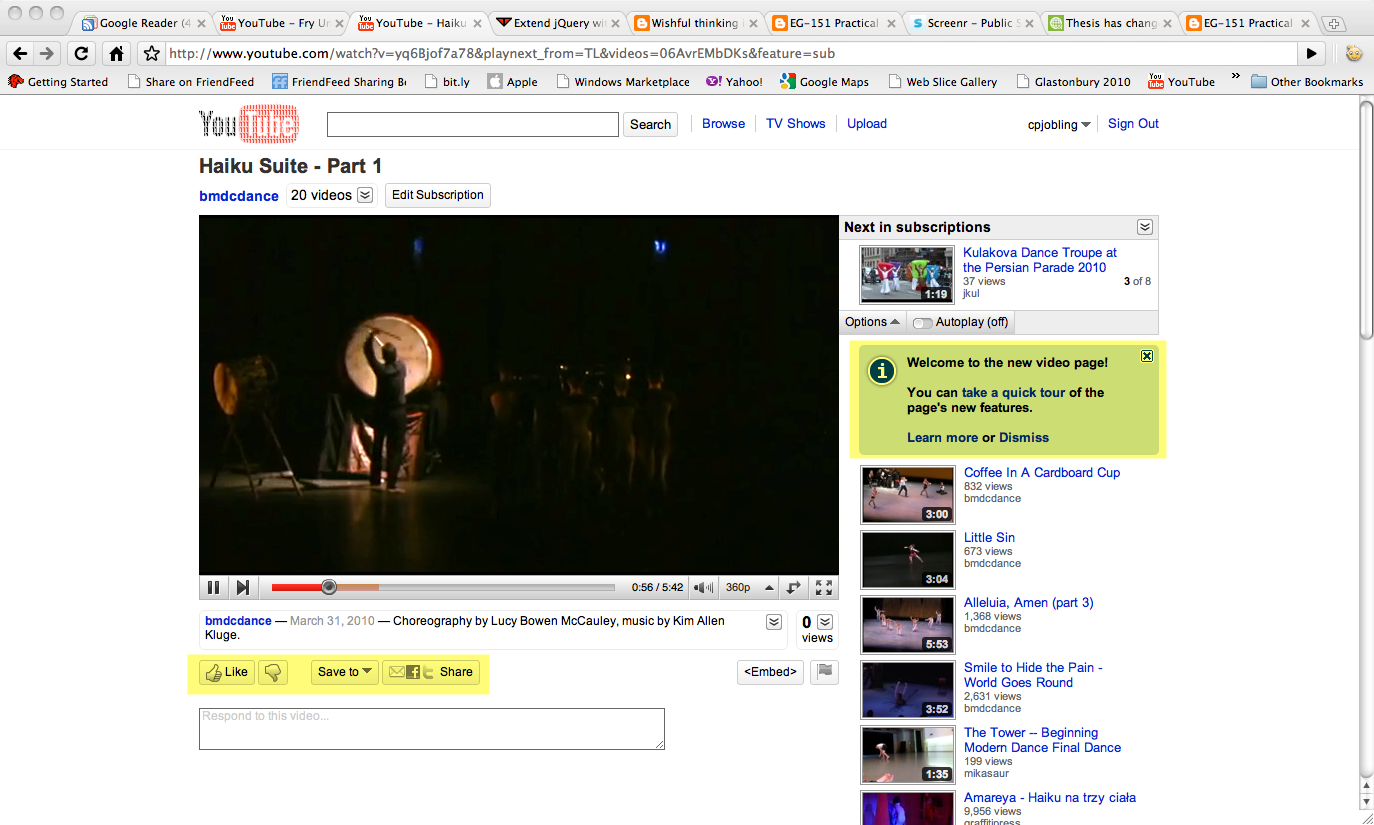
Just posted my last post and I noticed that I’d typed it’s when I meant its. This is a common error that I pick up my students on all the time, but it’s one that I make myself quite frequently.

Its is the possessive adjective form of the pronoun *it* used in the post in question as “YouTube has changed **its** user interface”. It’s is a contraction of *it is* as used in “*First impressions*: **it’s** [that is YouTube’s new interface *is*] certainly much less cluttered”.

Student beware: this type of error won’t be picked up with a spell checker … it might be picked up by a grammar checker … but don’t count on it. Since *its* is actually quite rare, as things don’t usually possess other things, it’s probably *it’s* that you want. But if you are unsure, ask yourself “is it its or is or is it it is?”

HTML, CSS and JavaScript for Apps ... why didn't I think of that?

Recently I’ve been catching up with the the excellent new blog/podcast The Changelog which covers

what’s fresh and new in open source

Listening to episode 0.0.8 (you have to be a geek to appreciate the episode numbering!), I became aware of an interesting new application development platform called Appcellerator Titanium.

Inspired by products like Adobe Air and Microsoft Silverlight, Titanium leverages the open source WebKit web-browser engine (used in Safari, Chrome, iPhone and Android) to create a software development kit (SDK) that allows the development of native desktop and mobile networked applications (or apps). The unique selling point? The heart of the platform is a web browser, you can develop applications using standard HTML, CSS and JavaScript that will run, with native look and feel, on Windows, Unix, Mac OS/X, iPhone and Android. It’s one of those brilliant, obvious with hindsight, “why didn’t I think of that?” kind of ideas … and as a teacher of web applications technology ***very interesting*** indeed!

Now, can anyone think of suitable undergraduate projects to try this out on? Answers in the comments!

**The Small-print**

Like most modern web-based services, Titanium is available via a “Freemium” subscription model. You can sign up, create a project and get the generated starter code and development tools for free. Support plans are also available on monthly/yearly per developer contracts. There are also a collection of free and paid-for training videos available. Video 101: Welcome to Titanium, hosted on Vimeo, is worth a look.

**More good stuff**

For more breaking news on interesting open source projects see also Explore GitHub and Tail the Changelog. I’ll endeavor to highlight other interesting projects and podcasts here.