Posts from 2007

Tube Map of the Internet


Discovered yesterday in my massive “first-day back” trawl of my RSS feeds was this interesting visualization of the most important web destinations shown as an underground or metro map (actually based on Tokyo’s I believe). One version is a clickable image (with pop-up snap shots of the sites themselves) that you can use as a browser start page which should provide hours of fun. You can also get PDFs that print the map in A3 size as well as the possibilty to buy A2 posters, use it as a desktop image or a screen saver (Mac OSX only!). The map was develoiped by Information Architects, a “strategic design agency” located in Tokyo, Japan.


Comments:

Dave Ferguson -

Chris, I'm glad you enjoyed the experience overall. Yes, a tweet chat, like Twitter itself, is a flood. I try and think of it as a river rather than a firehose: I can swim through it, or watch it flow without plunging in, or wander off and come back. As @heraclitus would have been surprised to see, you can step into the same stream again, thanks to search and archive tools. LOL (as Google's probably told you) is "laughing out loud," one of dozens of such shortcuts that emerged in the dawn of online discussion (usenet, IRC, CompuServ, what have you). Your readers may want to know that #lrnchat happens twice a week, on Thursdays, at first at 11:30-1pm EDT/4:30-6pm BST and then again at 8:30-10pm EDT, which is VeryLate:30 BST. More at lrnchat.wordpress.com/about.


Julia Ault -

I thought everyone had a pet rock at one time Chris! I have always taken LOL to mean Laugh Out Loud myself.


Chris Jobling -

I did too but you never know if those sneaky youngsters haven't made it something rude!


Inbox Zero

It’s been a while but I’m sort of back in harness after my vacation (even if actually at home in my pyjamas). One of the issues that always occurs after a period away is dealing with the email after a period away. To this end, this video by Merlin Mann of 43folders may help. It provides some useful tips about how to deal with after-vacation email as well as the ongoing problem of dealing with email on a daily basis. It comes down to a simple strategy for processing email: empty the email inbox every time that you visit it. You do this by some variation of a processing procedure that does one of these five things with each message:

  • delete (or archive)

  • delegate

  • respond

  • defer

  • do

Watch the video for more detail and for the interesting discussion (with Google knowledge workers) and be inspired!

http://video.google.com/googleplayer.swf?docId=973149761529535925&hl=en-GB

Arthur Austen Prize


At yesterday’s School of Engineering Graduation Reception, Multimedia Technology graduate Andrew Robinson was awarded the Arthur Austin Prize. Andrew is accompanied by Professor Nigel Weatherill (Head of School), Jim Lindley, Honorary Treasurer of the Wales South West Local Branch of the Insitution of Engineering Technology, and me.

Arthur Austin was a long serving member of the South West Wales Branch of the IEE and was a pioneer in cinema. The award is named in his honour and is a gift of the Wales South West Branch of the IET. The photograph was taken at Fulton House, July 19th, 2007

Graduation Day


Like any proud father I was happy to have helped my Institution deliver another batch of ICCT graduates. Yesterday, it was gradutaion day and some of the “class of 2007” are pictured here. Good luck chaps and don’t forget me, particulary when you’re rich.

VOD: More on Windows-Centric DRM

An interesting article “Why TV on demand insists you use its chosen browser” by Kate Bevan in today’s TechnologyGuardian indicates that it is not only the BBC that has wedded itself to a Microsoft Windows XP/IE/Media Player solution to its Video on Demand (VOD) service. Apparently Channel 4’s 40D service has the same limitations, and I can report first hand that SKY Anytime doesn’t work on Vista either. Apparently it’s all a question of reaching the most users while satisfying the distribution restrictions of the rights holders.

There’s an additional issue that I found with Sky Anytime and that is the DRM is tied to the CPU, so make sure that you install it on a Windows XP that you don’t intend to upgrade to Vista. I upgraded my laptop, but even after uninstalling the software (which no longer worked) I couldn’t reinstall on another PC because my account was still tied to the Laptop! A long call to Customer Services is likely to be the only solution. Note to the developers: “Why can’t uninstalling reset the link to the CPU that is no longer running the software?”

Why didn't I think of that?

In my pursuit of procrastination (I’m supposed to be writing supplementary [summer resit] examinations) I’ve been through my feeds and am now watching Stephanie Booth’s excellent Google Tech Talk on Localization (which incidentally is a trickier problem than most English speakers realise). Whilst listening, I was following the links to Stephanie’s blog Climb to the Stars and from there to her del.icio.us link collection and discovered a useful tip. She bookmarks links to the IMDb (Internet Movie Database) record for the films that she’s seen and tags them films seen cinema , films seen dvd, etc. What an elegant, great, simply superb, absurdly simple idea! Ideal for the completist who must make sure that he’s seen every one of the 1000 films to see before you die before he dies. And it’s so easily adapted to books, recordings, rugby matches or anything else you’d want to remember.

Oh … and Stephanie’s talk on the issues of localization for web application developers is also thought provoking and well worth watching.

BBC iPlayer for all: sign the petition

You may have heard about the BBC’s plans to release iPlayer which will allow license fee payers to watch BBC programs on their computers. Unfortunately, the system is targeted at Windows and uses Microsoft Media Player and Digital Rights Management (DRM) to protect the content. While the use of some form of DRM to protect the content seems to me eminently sensible (I don’t see how the BBC, which outsources most of its production, could offer any form of Video on Demand (VOD) without protecting the Artistic Property of itself and its partners), the choice of Microsoft Windows, Microsoft Media Player and Microsoft DRM does potentially disenfranchise a small but significant minority of computer users. If you are running any version of Linux, Macintosh or even Windows Vista, iPlayer will not work for you. The community of the disenfranchised have created a petition on the Prime Minister’s e-petition site

We the undersigned petition the Prime Minister to prevent the BBC from making its iPlayer on-demand television service available to Windows users only, and instruct the corporation to provide its service for other operating systems also.

If you care, go to the petition page and sign it yourself! The deadline is 20 August 2007 and at the time of blogging, there were 9,635 signatories.

“Goodnight, and Good Luck”

In a knowing echo to Edward R. Murrow’s indictment of Senator Joe McCarthy (recently immortalized in George Clooney’s film film), Keith Olbermann has used the closing of his eve-of-July 4thMSNBC Countdown program (link includes video) to publicly castigate the current President and Vice President of the United States – suggesting that they both resign. To paraphrase the tag line:

“I didn’t vote for him,” [John Wayne referring to JFK] once said, “But he’s my president, and I hope he does a good job.”

That—on this eve of the 4th of July—is the essence of [U.S.] democracy, in 17 words. And that is what President Bush threw away yesterday in commuting the sentence of Lewis “Scooter” Libby.

Powerful stuff! Thanks for SassyBlonde for bringing this to my attention!

Switching from Desktop to Online Tools

Tom Johnson strkes a chord with his latest blog posting on i’d rather be writing wherein he talks about moving from desktop to online tools. Here’s his list which of tools, many of which I find I am already using (but not exclusively yet): - Instead of Microsoft Outlook, use Gmail. - Instead of FeedDemon, use Google Reader. - Instead of Microsoft Word, use Google Docs and Spreadsheets (if only!). - Instead of to-do lists and other notes stored on Word documents, use Mediawiki Todoist and Dokuwiki. TiddlyWiki is also good! - Instead of a journal that you keep on your desktop, use WordPressBlogger. - Instead of adding favorites to IE, use Del.icio.us. - Instead of storing documents in folders, store them in a file directory on a Web host. This would be a good thing to do but which? - Instead of keeping photos in folders, use Flickr (you’ll need to pay if you have a lot!).

Interesting comment from Jo which I’m afraid I have some sympathy for: > […] as for Google as an operating system, it has other potential as well. Last year my university traded WebCT for Blackboard, a course management system so heinous that I spent last spring teaching a course using only Google tools (especially Google Groups and Google docs). Now if I could only wangle a sabbatical with Google to help them move into the higher-ed market…

Powered by ScribeFire.

First-step with Yahoo! Pipes

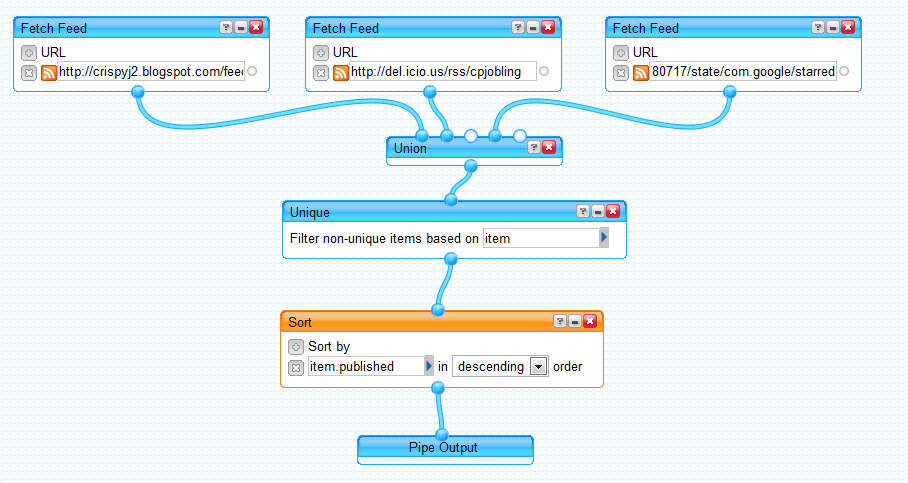
First step with Yahoo Pipes

I’ve been reading a lot recently about Yahoo! Pipes so I thought I’d give it a try myself. I created a simple feed aggregator by merging the RSS feeds for my Google reader starred items, del.icio.us, and the RSS feed for this blog together and output as a new feed.

Resulting RSS feed

I had to do some minor manipulation, for example to remove duplicates (which you get when you star, bookmark or link-blog the same item) and to sort the merged feeds into descending order of publication date. Then I took the output of the resulting feed and added it to my iGoogle page. The result is a nice summary of my recent activities.

This was a very quick experiment, and I’m sure there’s a lot more that you can do: for example, only the link title and URL is captured, not the text, nor any multimedia content. But it’s very easy to use and worthy of further experimentation.


Comments:

gbswales -

Well my experience as a child was one of hating maths - all that "chalk and theory" - when I had to visit maths again as part of my BSc I looked forward to being taught in a more imaginative way that might capture my interest - it turned out to be delivered by a lecturer using the same chalk and theory method (not to mention almost illegible handwritten photocopied notes). If anything I was even more turned off than the first time despite the 45 years of "progress" inbetween the two experiences. I once saw a more enlightened teacher presenting a lesson about fractions to primary kids - she spent most of the lesson discussing what fruit they liked and how they could share the fruit they collectively chose with their friends....the math bit came in the last few minutes of the teaching session but I am sure that the kids learnt more about fractions. Now I am not suggesting you get secondary kids cutting up bananas but I do think that starting any lesson from a practical illustration about why you might want to understand it is a good way to grab interest and attention - who is ever inspired by "you need to understand the basics before we move onto more interesting stuff"