Posts tagged with "Uncategorised"

Happy 20th Birthday, World Wide Web

I’m sure I’ll not be the only one, but let me add my congratulations to Sir Tim and his wonderful, annoying, ubiquitous invention.

Happy 20th Birthday, World Wide Web

via Jane's E-Learning Pick of the Day by Jane Hart on 3/13/09

Scientific American has a great feature on Tim Berners Lee and the Web.  The reason?

"CERN on March 13 celebrates the 20th anniversary of a proposal entitled, "Information Management: A Proposal," by Tim Berners-Lee, which would become the blueprint for the World Wide Web"

Happy 20th Birthday, World Wide Web

[Via Richard Nantel on Workplace Learning Today – a great multi-author blog from the analysts at Brandon Hall]

Posted via email from Half baked but crispy

Effective Presentations

This new Flowgram weaves the best of the Internet’s sites on presentations into a briefing presentation for my research project students. At the time of writing, there is no soundtrack but check back later. Important note, Flowgram goes off line on 30th June: you probably won’t see the embedded presentation after that date.

http://www.flowgram.com/widget/flexwidget.swf?id=haycqp6hibqjxr&hasLinks=false

Flowgram has been playing up lately: it takes an inordinate amount of time between uploading PowerPoint slides and them appearing on the site. Hopefully it’s just a temporary glitch but I’ve had to embed the web sites into the actual PowerPoint files to get this to work in my live briefings!

Education theories on learning [via feedly]

An informal guide for the engineering education scholar has been published by the Engineering Subject Centre (ESC) at the Higher Education Academy (HEA). It’s aimed at engineering educators (like me) who don’t have much idea of the theory of education and educators (also like me) who want to do research in this area. Hope it delivers what it promises!

[Published: 10 days ago shared via feedly]

Posted via email from Half baked but crispy.

Testing Disqus

I have noticed that a few people in my Friendfeed have been using a new (to me) social commenting service Disqus to mediate their blog comments. Unable to resist trying out “yet another Web2.0 service” (YAWTS), I’ve signed up. After some adjustment to my Blogger template to include the necessary third-party code, my comments are now using Disqus and you can subscribe to a post’s comment stream, or all my comments. Should be a nice way to monitor comments on my posts if nothing else!

Why not try it yourself: it has some of the features that your Blogger comments engine is missing such as threaded comments, cross-social network links and reblogging. I just hope that it doesn’t go the way of Swurl!

The Death of Swurl


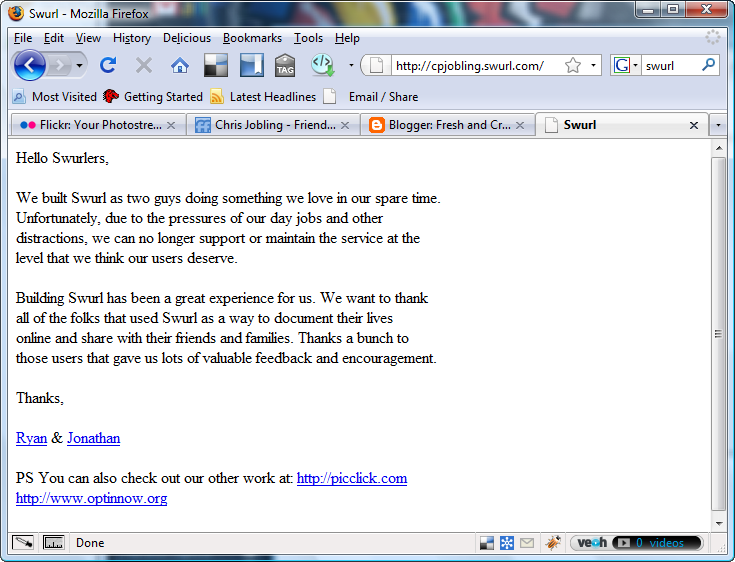
Swurl was a lifestreaming tool with a great interface that I was subscribed to since I read about it in Read Write Web back in July last year. Unfortunately, without warning, it’s now gone and taken my life with it! All that is left is the apologetic note illustrated.

Luckily I still have my friend-feed, tumblr blog and netvibes home page.

Moral: don’t get too attached to a single Web 2.0 service! In the current economic climate, there’ll be a few that fall by the wayside.

More on Euler

I am grateful to my friend and former Swansea colleague Dr Farzin Deravi of University of Kent at Canterbury who read my blog post on Euler’s identity (“The Most Beautiful Equation in the World”) via Facebook and told me about this video proof of the equation:

It’s well put together, but for me crucially omits the vital step that substitutes cos ? = -1 and sin ? = 0 to reduce e_i_? = cos ? – i sin ? to e_i_? = –1 + 0 which of course can be rearranged to give e_i_? + 1 = 0.

This was not the only “Euler Video” available on YouTube, looking further, I found this nice example, also a proof of Euler’s identity, that shows what you can do with a tablet and screen recording software.

Two very inspirational demonstrations of the power of video in the teaching of mathematical concepts.

How many blogs is too many?

I regularly post to three blogs. This one, which used to be work related, is now sort of miscellaneous. I try to keep my other blog @the.coalface, which is a multi-user WordPress blog hosted at my University, focussed on my reflections on my experiments with education technology. And I am a regular contributor to the Swansea Learning Lab community blog, where I typically re-post interesting items of e-learning inspiration and that I find in my daily trawl of my RSS feeds. 

However, it seems that I could do even more. As a member of the Eduspaces and Classroom2.0 community networks, I have two more blogs available to me. As an academic I have an entry on Academia.edu and could have a blog. I microblog on Twitter. I share favourites from Google Reader, my delicious bookmarks and some of my photos on Flickr. I even have some module related blogs in Blackboard for some of the courses that I teach. So is this all too much? Am I spreading myself too thin?

I have dabbled with various ways to aggregate all these strands of my life on line. For example, I have created a Swurl page, a FriendFeed, a Tumblr blog and a Netvibes public page. I even have a Yahoo! Pipe which aggregates some (but not all) of these and generates an RSS feed!

So which is the real me? Which should you follow?

The Most Beautiful Equation in the World

According to some, Euler’s identity is one of the most beautiful mathematical expressions in the world. The identity is
1 + e__i? = 0 (although electrical engineers like myself are more familiar with seeing it written as 1 + e__j? = 0).

DSC_0155*
Euler’s Identity, Technical Museum Berlin*

On a recent visit to the Mathema Exhibition at the German Technical Museum, Berlin, I took this photo of some art that represents this equation.

Lots of people like to take a break by sitting in the zero.

Why so beautiful? Because it neatly ties together five of the most mysterious numbers in Mathematics: 0, 1, e, ? and the square root of –1.

What does it mean? Euler’s formula is essentially a statement of the transformation from cartesian coordinates to polar coordinates for imaginary numbers: that is numbers that have a real part represented as a point on the x-axis, and an imaginary part that is represented by a point on the y-axis. It takes the general form
*
eix* = cos x +* i* sin x.

For the special case when x = ?: sin ? = 0 and cos ? = -1, thus ei? = -1 or ei? + 1 = 0.

How to write up a dissertation: Referencing

In about four weeks I will be giving a lecture to the Level 3 Engineering Dissertation class on proper referencing. I will probably want to cover the following ground:

  • Plagiarism (or how not to reference)
  • How to reference
  • A couple of referencing styles (I was thinking numerical and Havard styles).
  • Referencing tools: Word 2007, Zotero, Endnote.

There is a brief guide to bibliographic referencing that has been provided by the Library and Information Service at Swansea University which I will use, but I am also looking for examples of plagiarism that I can cite (properly) and any pointers to good on-line resources for using the referencing tools.

In a (very) brief Google search session I came across this nice interactive tutorial from Arcadia University that can be used in the lecture. I will tag others in my delicious feed using tags eg-353+referencing.

Hopefully, the resulting presentation will be good enough to join my existing presentation on How to Write a Technical Report on SlideShare.