
Posts tagged with "Blog"

#HEBlogSwap - The importance of showing your enthusiasm in large-group maths sessions - by Rebecca Jackson

Screenshot 2017-06-17 at 17.51.57

I’m going to say it: I hate maths. Well, not the sexy stuff that’s super interesting like zero, infinity, chaos, or probability but the easy stuff that ties your brain in knots when working in a shop - long division! (Still can’t do it…)

Why do I hate maths? Many fears and dislikes are rooted in bad childhood experiences. My fear of maths is down to Mrs Nameless, who physically dragged me out of class on more than one occasion, calling me out in front of all my classmates and using my full name to boot - the horror! How might my attitude to maths have been different if only I’d have had a kind and enthusiastic teacher who wanted me to see it was a fun game, which, I now understand is exactly what maths is!

Much of the time I don’t believe that there’s much difference in the needs and wants and hopes and fears of older and younger learners. Just as a primary school student needs a switched on and positive teacher, university students of maths might find their subject abstract and slippery, and would equally need someone enthusiastic and passionate about the mysteries of numbers to teach them.

How can you be enthusiastic as a university maths teacher? What if you genuinely love maths but wish you could connect more and show that enthusiasm? What if your classes are large and you feel you struggle to connect to your mega groups to help them see the gameplay and mystery of mathematics?
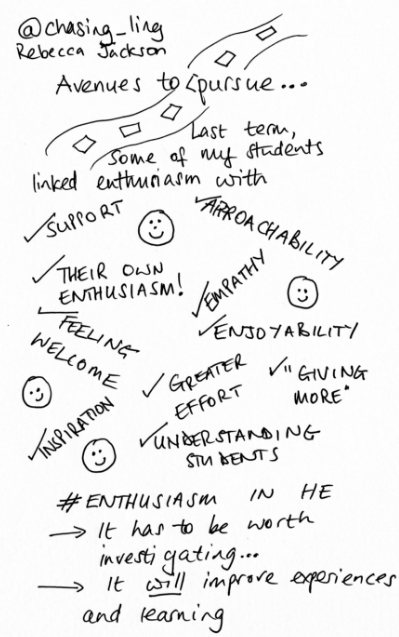
Screenshot 2017-07-06 at 10.03.10

Enthusiasm has huge power for creating emotional engagement in students. Feeling your enthusiasm is not enough. The biggest effects on positive learning outcomes for students are observed when cues of enthusiasm are clear and perceivable. This can then create an emotional contagion which helps your students to experience a similar emotional state to you about your object of enthusiasm - the maths, and the activities needed to explore it in all its beauty. Displaying behaviours of enthusiasm can help you to connect with a large room.

The literature is quite clear about what enthusiastic teaching ‘looks like’ - even if a lot of those observations come from non-HE research. (Most current research on enthusiasm in teaching is from primary and secondary education studies.) Enthusiastic teachers smile, use gestures, make use of space and body movements, make eye contact, draw on humour, and vary the tone of their voice, among other things.

There is absolutely no point putting on these behaviours. It’s emotional labour - faking it and causing pain to yourself - and students can sense it’s fake, which is worse than no enthusiasm! But, you could practice reflecting on what is enthusing you about your maths content/tasks, and ruminate on this to generate a state where you feel even more enthusiastic and buzzed, and you might then feel positive enough to work deeply and reflectively with trusted colleagues and/or students to ‘show’ more what you really are feeling. If you can work incrementally and in a safe space, you can build up your confidence and feel more comfortable about ‘showing’ your natural enthusiasm with regards to the behaviours just mentioned.

A step that we could take, especially in the times of lecture capture, is to watch back a session of a lecture. Essentially, you could do some microteaching. You could sit with a critical friend and examine where you are and are not exhibiting (genuine) enthusiasm behaviours. Be kind to yourself. Look at where those enthusiastic behaviours like smiling and varying tone occurred. Pat yourself on the back and really reflect on why you were able to show what you felt - what did you enjoy? What got you excited? Were there any puzzles or creative moments that you could draw on as a positive memory that you could use for inspiration on another occasion? Where you didn’t feel so enthusiastic, be curious as to why. Note down the task or the point that turned you off. Promise to ruminate on it and find three cool things or advantages about it that you can use to get excited next time. But, importantly, with the microteaching, you can bounce around ideas and get advice from a critical friend who can help you find opportunities to display your enthusiasm more ostensively, and you can watch where you are and are not growing over time - in a safe, scheduled, reflective way.

We don’t believe you should push too hard or go massively out of your comfort zone. Not at first. Work little and often, in increments, being reflective and being kind to yourself. In time, you’ll have a list of points and tasks that you love so much, and you will have practiced adding in more open demonstration of your genuinely felt passion at opportune moments.

The gains, we hope, will be large and rewarding. Asks your maths students whether and why they thought you were enthusiastic, and ask them to reflect on how it helped you. Simply add a question to your module feedback or create an informal survey at the end of the semester. When I have done this with linguistics students, they said it really made a difference, and that helped me to have some validation and further confidence in the approach. Please don’t be like Mrs Nameless - show as much enthusiasm as you are able so that as many of your maths students as possible experience positive affect, or emotional engagement, towards the wonderful world of maths. Please get in touch with Enthusiastic HE to discuss further - and to let us know how you got on!

Rebecca Jackson / @chasing_ling of @EnthusiasticHE wrote this blog post for Santanu Vasant's 13/09 #HEblogswap initiative. Thanks Rebecca for your advice!

Comments:

#HEBlogSwap – Sharing Practice and Building Community in Cyberspace : #ALTC Blog -

[…] Rebecca’s post for Chris’s blog: The Importance of Showing Your Enthusiasm in Large Group Maths Sessions […]


OneNote Class Notebook and Classroom Teams

In July's SALT Conference, I presented a demonstration of OneNote Class Notebook to my colleagues. As it was a bit chaotic and unstructured, I prepared presentation in Sway that I made available after the session. (I also promised a video which is still on my to-do-list.)

Interestingly, our own Paul Manning (@PaulCManning) and OneNote Central (@OneNoteC) spotted my Sway and after a short twitter conversation that turned to Microsoft Teams, @OneNoteC tweeted a useful collection of resources on Teams for Education:

https://twitter.com/OneNoteC/status/882682885865713664

Within this collection, there is a link to a Webinar "Modern Classroom Collaboration: Microsoft Teams in Office 365 for Education" hosted by Raanah Amjadi et al. of Microsoft Canada (Jun 8, 2017) which I signed up for yesterday and watched this morning.

It's well worth doing the same to get an inkling of how Microsoft is pitching @MicrosoftTeams and @msonenote as a classroom environment that looks viable as a replacement for institutional LMS and VLE offerings. I think that it may well disrupt the market for the simple reason that it's built on Office 365 and uses the same content delivery and collaboration tools that students will use after graduation. Perhaps, for the first time in this market, there is a set of tools that teachers are already using in their day-to-day work, that can be used to develop courses and activities that provide an authentic and transferable experience to students.

Office 365 for Education is free for all institutions from K-12 through Higher Ed so this is a very smart move!

I intend to introduce students on EG-252 to Teams and Planner (already available at my University) but if the Teams for Classroom features are activated in time, I may well use it for my modules EGLM03 and EG-247 next year.

Emerging into the light

I've decided to return to social media a bit earlier than planned. 

Here are two things that I thought I needed to share and brought me out if hibernation. For the first, I've been catching up on Bryan Alexander's discussions in his Future Trends Forum which can be viewed on this YouTube channel. I've been particularly interested in the discussion with Phil Hill on 'Towards the future Learning Msnsgement System' and 'The Future of Moodle' with Martin Dougiamas. Both good flipped learning opportunities for anyone embarking on a VLE/LMS review. 

Secondly, Chris Rowell posted a proposal for the establishment of a Digital Champions at Regent's University of London which is an idea that my Univesity could usefully steal.

Going dark

Over the last week or so, I have found myself getting more and more depressed about the state of the world and my place in it. The constant bad news about the UK election, Brexit, Trump, and the vile responses you read when you follow a Tweet stream on any of these topics. The crisis in Higher Education, too many students, falling student satisfaction, TEF, the stress of teaching and managing teaching, the false dawn of e-learning, analytics, AI; dire warnings about so-called "Generation-Z" students and their likely impact; and the devaluation of human relationships between teachers and their students. Etc, etc.

Last week we had the SALT Conference here at Swansea. I should be feeling invigorated and reactivated. I don't.

I've decided that perhaps the reason for my current despondency is that I've become addicted to Twitter (and other social media) and it's making me ill. So I've decided to go dark, for a few weeks at least. The tweet that will be posted when I post this will be my last for at least a month.

The Twitter, Google+ and Facebook apps are going to be deleted from my mobile devices.

I'm going to have an offline sabbatical; some me and my family time. I'm going to talk to colleagues; I'm going to read books; I'm going write and draw, with a pen, on paper. I'm going to think.

See you, perhaps, on the other side.

Comments:

Mandy Jack -

It is probably good to have a rest Chris, it’s all too easy to get swept away with it all. Sorry that SUSALT17 didn’t bring any respite though 😦


cpjobling -

Thanks Mandy. I feel better already but I'm trying to be strict with myself.


Digital content at #SUSALT17

On Wednesday, I chaired a presentation session at Swansea University's annual SALT conference "Reaching for Teaching Excellence" (#susalt17). In the session the three speakers all presented examples of what might be summarized as authentic assessment of students engaged in content co-creation through problem based learning.

First up we had Tanya May from Modern Languages who presented "Start where you are, use what you can: an online professional portfolio in the Spanish Class." For this work Tanya got her Spanish students to create a professional portfolio using Google Sites and therefore develop their language skills, professional profile, and digital skills. She was supported by her student James who walked us through his very professional portfolio.

We then heard from Patricia Rodrigez-Martinez of the Department of Languages, Translation and Interpreting on "Using Wix to create group websites for Business Spanish." For this work, Patricia got her students to work in groups, form a fictitious consultancy company and set up a site on Wix (a web-site development tool) to look at various economic aspects of a spanish-speaking country or region. Again, this provided to be a valuable opportunity to develop the students' language, research, communication, and digital skills. We again heard enthusiastic testimony from students who participated, this time in the form of recorded video.

Finally we had a presentation from Richard Davies reporting on some work done by himself and Pedro Telles of the Department of Law on "Using Whatsapp and Wikipedia as Learning and Teaching drivers." Here, the brief was to investigate the messaging platform WhatsApp from a competition law point-of-view and record their findings in the form of an article on Wikipedia. Some interesting tensions between the traditional essay-writing style of student work and the neutral-point of view required by Wikipedia editors resulted.

All of the presentations were attempts to give the students valuable transferrable skills via a problem-based learning approach, an authentic task and the communication of their results through digital media. It was interesting that students were reported to have been initially reluctant using the same excuse "I don't do digital" that many of my colleagues make (or are accused of making). Once the initial reluctance was overcome, it would seem that all found the experience valuable and the various projects seem to have been a great success.

The questions from the audience concerned the assessment of the work and one suggestion the speakers may wish to consider for next year is whether students could be involved in negotiating that as well. Peer assessment would also be worth exploring. It became clear from the presentation and questions that it is still important for teachers to scaffold the activity.  Tanya and Patricia established a timeline and checklist for their students. Richard reported that his students were well briefed but nonetheless, some of the work was only uploaded to Wikipedia at the last minute. So normal student behaviour in terms of deadlines was still in evidence.

It was also interesting to me that some of the University's own procedures occasionally get in the way: for example for the Wikipedia project, the articles were checked by TurnitIn before they were uploaded to the wiki. It would be informative to see if Wikipedia's own community standards would be sufficient to police that.

To some extent, we are already doing something similar to these reported works in our Group Design Exercise (EG-252) for which our Electrical and Electronic Engineers have been making websites for many years now. However, as an approach, portfolios and creation or co-creation of well-researched digital artefacts is not something we use widely in Engineering. But we are considering assessment reform and problem-based learning so there are lessons that we can learn from this session.

Personally, I quite like the idea of my students contributing to Wikimedia - a Signals and Systems Textbook created by students by students perhaps?

OneNote Class Notebook and Classroom Teams

At Wednesday's SALT Conference, I presented a demonstration of OneNote Class Notebook to my colleagues. As it was a bit chaotic and unstructured, I prepared presentation in Sway that I made available after the session. (I also promised a video which is still on my to-do-list.)

Interestingly, our own Paul Manning (@PaulCManning) and OneNote Central (@OneNoteC) spotted my Sway and after a short twitter conversation that turned to Microsoft Teams, @OneNoteC tweeted a useful collection of resources on Teams for Education:

https://twitter.com/OneNoteC/status/882682885865713664

Within this collection, there is a link to a Webinar "Modern Classroom Collaboration: Microsoft Teams in Office 365 for Education" hosted by Raanah Amjadi et al. of Microsoft Canada (Jun 8, 2017) which I signed up for yesterday and watched this morning.

It's well worth doing the same to get an inkling of how Microsoft is pitching @MicrosoftTeams and @msonenote as a classroom environment that looks viable as a replacement for institutional LMS and VLE offerings. I think that it may well disrupt the market for the simple reason that it's built on Office 365 and uses the same content delivery and collaboration tools that students will use after graduation. Perhaps, for the first time in this market, there is a set of tools that teachers are already using in their day-to-day work, that can be used to develop courses and activities that provide an authentic and transferable experience to students.

Office 365 for Education is free for all institutions from K-12 through Higher Ed so this is a very smart move!

I intend to introduce students on EG-252 to Teams and Planner (already available at my University) but if the Teams for Classroom features are activated in time, I may well use it for my modules EGLM03 and EG-247 next year.

Comments:

Debbaff -

Thanks for sharing this Chris it looks really helpful :) I hear your presentation went down really well ... only wish I had the time to go and see it instead of running around behind the scenes ...


cpjobling -

Thanks Debbie. It seemed a bit chaotic to me hence my promise to provide extra resources. I'm drafting my chair reflection and hope to post later today.


cpjobling -

You need to take a break from organising conferences and be a delegate for once. Recharge the batteries.


My CPD in 2016: Part 2 #LTHEChat

LTHEchat is another ongoing twitter chat that takes place one hour every week during University term time (on Wednesdays at 8:00 UK time). The purpose is to discuss various issues around Higher Education. The event was launched by Sue Beckingham (@suebecks) of Sheffield Hallam University and Chrissi Nerantzi  (@chrissinerantzi) of Manchester Metropolitan University in October 2014. Since 2015/2016 the event has been organised by a rotating team of volunteers who run it for a semester.

My first time attending #LTHEChat was November 5th, 2014. In 2016 I attended twenty times as is evidenced by my tweets from my timeline  (search #LTHEChat). When I cannot attend, I typically read the story which is published shortly after the chat. In 2016, I read 6 of the curated stories.

In 2016, I was invited to join the organising team during the January-March semester and I led the organising team in April-June. Organisation #LTHEChat means contacting the host, setting up the blog post, programming the automated tweets for account @LTHEchat, attending the chat and encouraging the community, curating the story and, in my case, creating a network map using TAGSexplorer. I was involved in the organisation of ten of the 2016 chats.

I was also awarded the Golden Tweeter award in July 2016.

Here is a summary of mt LTHEChat activities that counted towards my CPD in 2016. In the titles (A) means “attended” [1 hour CPD], (O) means “organised” [3 hours CPD], (S) means “read the story” [30 minutes CPD].

You'll also find some of my reflections on individual chats by following the LTHEchat category in this blog.

My CPD in 2016: Part 1 #HEAChat

As part of my maintaining my professional registration as a Chartered Engineer (C.Eng.), I am now required to record and reflect on my CPD and have my training records for 2016 audited by the IET. This has meant going back through my calendar and trying to recall all the CPD events and activities that I was involved with for the last 18 months so that I can populate my historic data and then hopefully continue to record events in more real time thereafter. The IET has an online system for this called Career Manager, but once I'm up to date, I think it will be more beneficial to me and my readers, if I record my reflections in this blog and link those back to the IET's records.

As part of my submission, I have been recalling my attendance at the monthly #HEAchat and here is a record if the events that I participated in last year. Those marked with an asterisk I actually participated live on the night. I consider those to be worth 1 hour CPD. The others that took place last year, I didn't participate live, but I did follow up by reading the Stories. I am giving those a weight of 30 minutes CPD.

For the first two events, there doesn't appear to be a working link to the stories neither in the blog posts nor my twitter archive, but I'm assuming that there must have been and that I read through the stories. If anyone has working links, perhaps they could let me know via the comments.

The four dimensional conference (*)

27th January 2016

Blog: https://www.heacademy.ac.uk/blog/four-dimensional-conference-using-social-media-conferences

The rearview mirror: Embedding conference learning in your teaching practice

27th February 2016

Blog: https://www.heacademy.ac.uk/blog/rearview-mirror-embedding-conference-learning-your-teaching-practice.

It looks like I made a story for this one: See Unofficial Storify of #HEAchat/#LTHEchat February 2016.

Teaching Excellence in Arts and Humanities

30 March 2016

Story: https://storify.com/HEA_chat/teaching-excellence-in-the-arts-and-humanities

Teaching and Learning in Law (*)

27 April 2016

Story: https://storify.com/LTHEchat/heachat-and-lthechat-27-april

New to Teaching

25th May 2016

I failed to attend this one following my accident last year! But I certainly read the story whilst recuperating.

Story: https://storify.com/cuthbert_kate/new-to-teaching-what-makes-for-a-successful-entry-

HE Teachers as Pedagogic Researchers (*)

28th June 2016

Story: https://storify.com/jess1ecat/heachat-28th-june-2016

Connection for Retention- building effective learning relationships (*)

27 September 2016

Blog: https://www.heacademy.ac.uk/blog/connection-retention-building-effective-learning-relationships.

A post I made at the time: #HEAChat/#LTHEChat on Student Retention.

Story: https://storify.com/Mannerings69/connection-for-retention

Striking a balance between internal and external pressures for using survey data

26th October 2016

Blog: https://www.heacademy.ac.uk/blog/striking-balance-between-internal-and-external-pressures-using-survey-data

Story: https://www.heacademy.ac.uk/blog/striking-balance-between-internal-and-external-pressures-using-survey-data

Interprofessional partnerships & collaborative practice (*)

25th November 2016

Blog: https://www.heacademy.ac.uk/blog/interprofessional-partnerships-collaborative-practice

Story: none published?

All in all, I reckon that that's 5 hours CPD event by participating in the tweet chats and 2 hours self learning in 2016.

Inclusion is the key to successful TEL

In this article published by Turning Technologies - makers of audience response system TurningPoint, clickers and ResponseWare - Professor of Chemistry Education at the University of East Anglia and National Teaching Fellow Simon Lancaster (@S_J_lancaster) discusses how he is encouraging his colleagues to use Technology Enhanced Learning (TEL) to engage students in lecture theatres. Here is a video of Simon's keynote from the 2015 Sheffield Hallam University Learning and Teaching Conference in which he expands on and demonstrates these ideas.

[youtube https://www.youtube.com/watch?v=54m5D6cumts&w=560&h=315]

Reposted from the LTEC Blog.

My Open Story for #101openstories

https://flic.kr/p/8CBBk5

As an engineer with a keen interest in software development and the web I suppose I come to "Open" with a philosophy formed from my exposure to the Open Source Software movement. I remember reading Raymond's The Cathedral to the Bazaar, and being fascinated by Richard Stallman, the Gnu Project, and his idea of Copyleft introduced by the Gnu General Public Licence (GPL). When it came to YouTube and Flickr, making my works available via a CC-BY licence seemed the right thing to do. On the web, I've used Wikipedia extensively (as you can see from this post) and would agree with others that it's one of the greatest Open Educational Resources that exist. I have a source code repository on GitHub where the sharp eyed may find the odd teaching resource made available to the public without necessarily having the right permissions.

As a practitioner, I suppose my Open Educational Practice began when I launched this Blog back in 2004. Fresh and Crispy (the name is a pun on my initials) was originally hosted on Blogspot. It has moved a couple of times to a various hosted WordPress and Ghost blogs on shared servers and virtual private servers before ending up hosted on WordPress, albeit with my domain name attached. Most of my early posts were around programming technologies like Java and Web applications. I joined Twitter in April 2007:

https://twitter.com/cpjobling/status/24929041

and a lot of my early tweets are about the Swansea Learning Lab, an early community of practice here at Swansea University. Here's a typical (rather depressing) tweet:

https://twitter.com/cpjobling/status/1400200315

I suppose a breakthrough for me came as a ed blogger came when I joined the Connectivist MOOC Plenk 2010 in September of that year.

I remember being dragged in and becoming somewhat obsessive about curating the discussion boards in that MOOC -- the evidence of which seems to have sadly disappeared -- but I was honoured by being called a Meerkat by one of the participants:

https://twitter.com/cpjobling/status/27352015957

I started tweet chats quite early, #lrnchat (still going strong) was one of the first as the tweet above testifies.

Since then I've attended virtual ALT conferences, JISC and HEA events, been a participant and mentor on #BYOD4L, and an organizer on #LTHChat. and one or two further MOOCs.

I find it difficult to reflect on what benefits there have been for me, but there must have been lots. It's even more difficult to judge what impact I've had. But I must have gotten something out of it along with sufficient positive feedback from my virtual friends and real colleagues otherwise I wouldn't continue to be engaged.

Comments:

Chrissi Nerantzi -

Hi Chris, thank you so much for sharing your journey into openness through making connections with people. While we are often critical about MOOCs, and I include myself, we can see that many of us were inspired by these and took some of the ideas forward. I have not seen that #LRNchat you mention. Will have a look. It has been a pleasure to get to know you in this open jungle and I hope one day we will meet in real life too. Chrissi


cpjobling -

Thanks Chrissi. The problem with #lrnchat is that it happens around 1:00 am on Fridays! But it still happens every week I think.


Chrissi Nerantzi -

Thank you Chris. Will have a look when I have a little bit of time.