Just read Stephen Downes’ article on the Huffington Post that announces that registration for Connectivsm and Connective Knowledge 2011 (cck11) — starting 17th January — is open. I definitely won’t have the personal resource to do much there, but it’ll be interesting nonetheless.
Recent Posts
Time for a new MOOC?
Jim Groom is getting ready to launch another massive open online course (MOOC). Tony Hirst, who drew my attention to Jim’s course Digital Storytelling (ds106.us) with this post: Massive Open Online Courses all you need to know, has curated a few videos from PLENK2010 facilitator Dave Cormier on the philosophy of a MOOC.
I’ve signed up for Digital Storytelling, but I expect my role to be more as a lurker than turned out to be the case on PLENK. One reason for this is that my workload is likely to be crazy in early 2011. But we’ll see. The course is due to start on January 10th, 2011.
Of technical interest is that Jim’s MOOC is going to be facilitated via a course platform based on WordPress. There may be some lessons to be transferred to my institution which is looking to create a new community of practice around that platform.
Things to Do
Next year I’ve got a fairly busy schedule. Here are some things that I might be blogging about. I record them here as an aide memoir:
- Large group assessment
- The “Flip”
- Socratic questioning
- Peer Instruction, Assessment and Support
- LiveScribe Echo
- Social networks
- Student employability and entrepreneurship.
Technically, I expect to be playing with Drupal, WordPress, BuddyPress, Moodle and Elgg and maybe, if there’s time, Ruby on Rails 3. I might submit something (probably a poster) to ALT-C 2011.
I also realise that I should take the opportunity to take a look back at a year on Fresh and Crispy, so expect a post on that before December 31st.
Lookback at 2010: Tool of the Year
In the media, as the shortest day approaches and with it the end of the old year, it’s traditional to look back. Here is the first of my retrospectives on 2010.
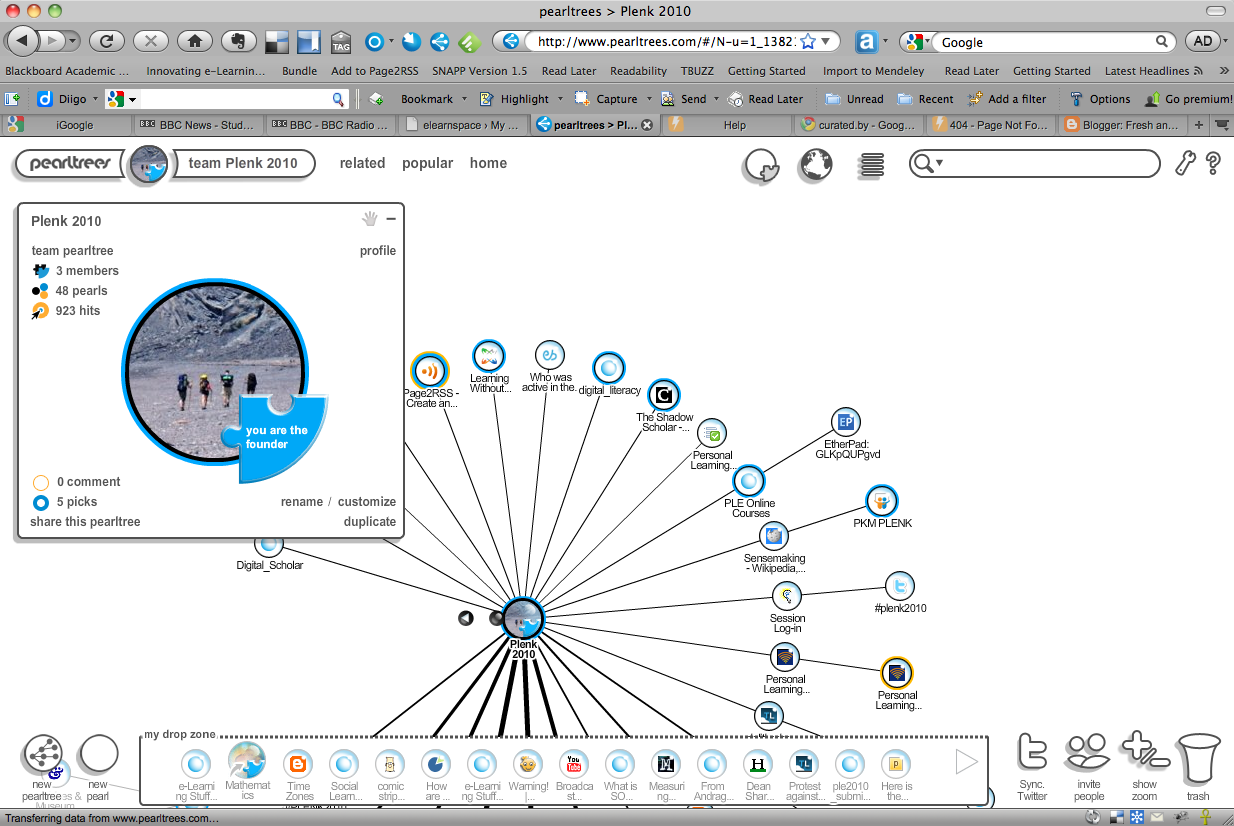
My tool of the year is Pearltrees (http://www.pearltrees.com), which I discovered during PLENK2010. I’ve used this as both a curation tool (see my Plenk2010 collection) and as an exploratory learning object builder but it also has a social network discovery and connection building capability and recently added a group/team curation feature. It also provides a set of well designed browser extensions that make it a joy to use. Pearltrees is the best tool to come out of France that I’ve seen and deserves to be better known. Its one disadvantage … it uses Flash so won’t work on the iPhone or iPad! Maybe there’ll be an “app for that” one day.
Other tools discovered or rediscovered this year worth mentioning:
- Twitter and Tweetdeck became part of my life!
- Amplify has great potential.
- Google forms came to the rescue when a bespoke application that I wrote failed under load.
- Google presentations did what SlideShare couldn’t.
- Elluminate became important several times this year, but I fear that it’s licensing costs will kill it now that it’s owned by Blackboard.
- iPhone and podcasts — education for the 15 minute commute.
To Lurk or Not to Lurk, That is the Question
There’s an interesting debate forming around this post from George Siemens (My Personal Learning Network is the most awesomest thing ever!!) and a response from Jenny Mackness (In defence of lurking).
George’s stance is that you can’t really learn in a community unless you are contributing something, Jenny’s that it’s OK to observe and not contribute. There are lot’s of other interesting points of view expressed in the comments.
To me, I feel I got more out of PLENK2010 by being an active contributor, although in the end I wasn’t sure if I’d learned that much. I think there’s a parallel to be made with large group teaching as a whole: in a lecture of 250, it’s going to be a brave soul who contributes. Perhaps the same is true of a MOOC. Maybe, PLENK2010 was just too big, and the people who “lurked” will be active participants next time. Maybe, it needs to be M for “medium-sized” rather than “massive.”
Winter

Stump
Originally uploaded by Chris P Jobling
Winter has come early this year. No snow yet in Swansea, but cold enough for frost.
For more see Frost on Flickr, and listen to Dylan reading his poem A Winter’s Tail (curated by Poetictouch.com), which seems quite appropriate.
elearnspace › Will online lectures destroy universities?
Via OLdaily, November 2010.
See this Amp at http://bit.ly/hj1COx
Diaspora: one network to rule them all? Or one too many?
Alan Cann today announced the availability of the alpha release of the new distributed social network Diaspora. It’s seems to be available without the need for invitations and you can get an account by registering at http://diasp.org. Once registered, you’ll have a handle: mine is cpjobling@diasp.org.
One unique selling point (USP) is that Diaspora has ways of organizing your various networks around aspects of your social networks. In my case, as well as the default Work and Family aspects, I’ve created an aspect for PLENK2010 and e-Learning folks. Another obvious one would be an aspect for the Swansea Learning Lab. Once these are set up you can post messages that will be received by all or a selected sub-set of your contacts. This has the potential to be much more powerful than the everyone’s my friend model of Facebook and Twitter.
Another USP is that, when it’s finally released, it will be possible to host your own Diaspora server which will be able to link into the network of Diaspora servers.
To use Diaspora, you need to be using a modern browser (it’s an HTML5 application) and should probably expect user interface changes, bugs and intermittent availability. At the moment it supports status reports, aspects, chat, and photo sharing (by file upload). You can also link your Diaspora account to Twitter and Facebook and control messaging to these.
It will remain an open question as to whether Diaspora will become the social network or whether it’s a case of one too many.
SOCRAIT: If they build it I will come
Those of you who are regular readers will know that I spent 10 weeks from September to November immersed (almost literally) in the Massive Open Online Course (MOOC) on Personal Learning Environments, Networks and Knowledge (PLENK2010). As already reported, one of the highlights for me was the guest appearance of Maria Andersen and her intriguing proposal for developing SOCRAIT, a Socratic questioning layer on the internet consisting of a Learn This button, a social gaming-like motivation and reward system, and channeled expertise designed to provide a personalized learning for the masses. A disruptive technology indeed!
Well, a pre-print of Maria’s paper The World is My School, due to appear in the January-February 2011 issue of The Futurist, has just been posted (http://bit.ly/socraitpdf) and Maria is looking to spread the word virally using the twitter hashtag #SOCRAIT.
I invite you to read Maria’s paper and use the comments to answer these questions:
- Could a system like SOCRAIT work?
- Would you use it?
- How would you implement it?
- Could you see yourself using it in your own learning?
- Could you adopt it in your teaching?
- Would it be disruptive?
I’m pretty certain that if someone builds SOCRAIT, I will use it.
JISC Innovating e-Learning 2010
This week I am attending the JISC-sponsored online conference Innovating eLearning 2010. Any posts I make here or in the Community Blog are likely to be on my reflections from this conference. The conference is for paying delegates only, but some materials are out in the public Internet, and I’ll refer to them where appropriate. The twitter back-channel is using the hash-tag #jiscel10.