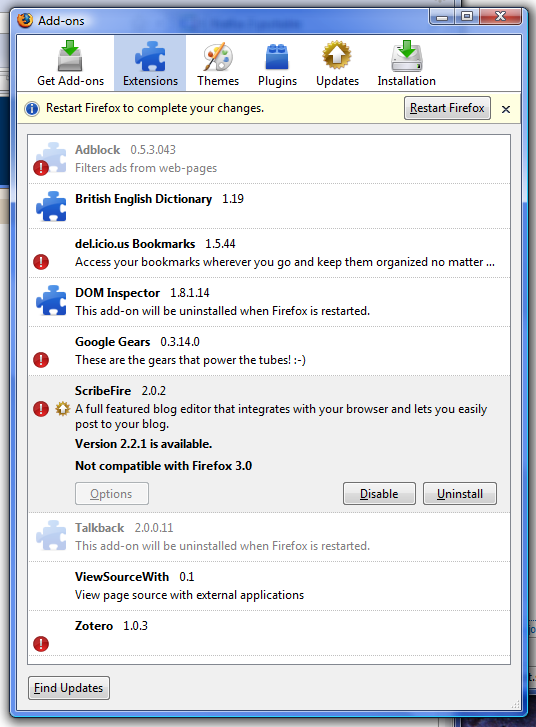
A problem with Firefox 3 is that not all plugins are ready for deployment. The attached image shows my current set (on my laptop I have a couple more). Of particular note are del.icio.us, ScribeFire (for in-browser blogging) and Zotero (bibliographic database).
Google gears is also not yet compatible so support for offline working for Gmail, Google Reader, and Google Docs will not work. I find that I don’t travel enough with my lap top for this to be an issue.
I assume that most plugin providers are waiting on the final release before upgrading their plugins, but if any plugin is important to you, it might be worth holding off installing Firefox 3 for now. If you want to try it, a portable version of Firefox 3 RC1 that runs from a USB memory stick is also available. Alternatively you can run Firefox 2 and 3 on the same machine if you create a new profile for the latter. I wish I’d done that!
Update
I just discovered that there’s a beta version of the del.icio.us plugin for Firefox, so that’s one indispensible tool that I won’t have to live without!
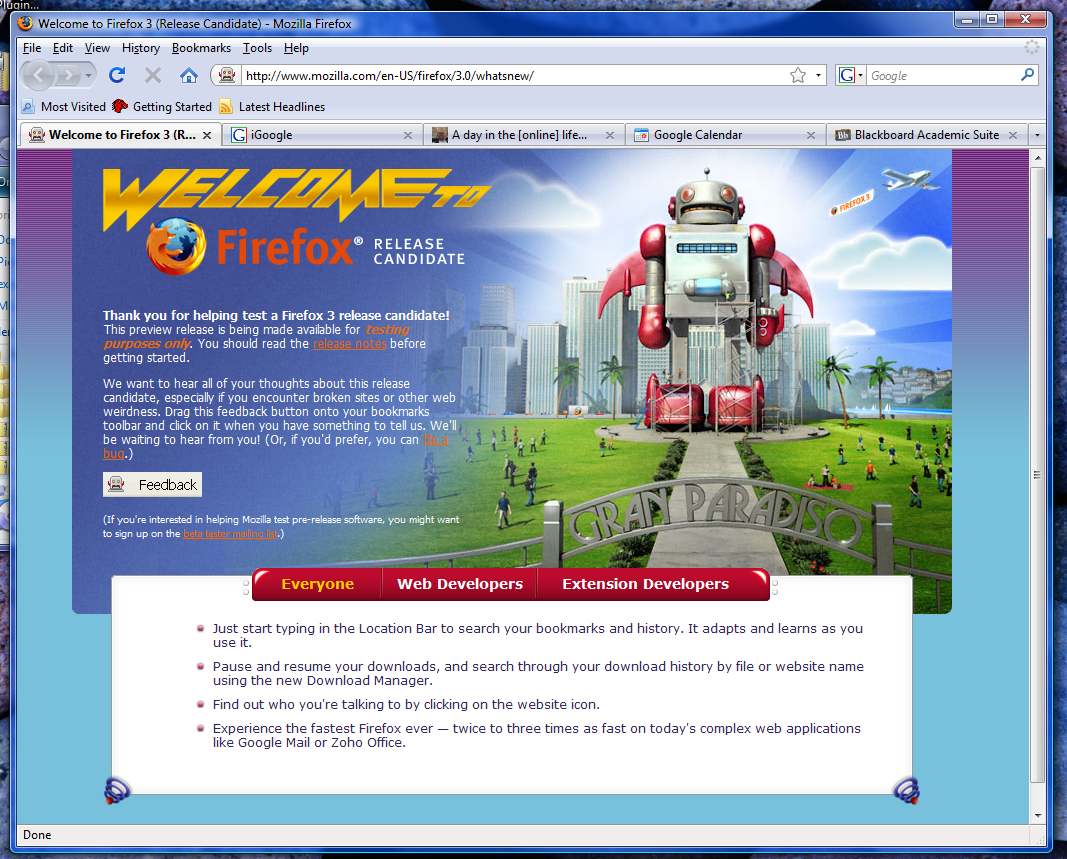
I installed release candidate 1 of Firefox 3 today. I will be giving it a trial run and reporting on any nice features in a future blog. First impression: nice sexy Windows Vista look and friendly welcome page (illustrated). I’ve only installed it on my office desktop so far because my laptop is my main machine and it has a few plug-ins that might not work. So I’m hanging fire there which gives an opportunity for comparison.
I have just posted an article with demo screencasts on my work blog @the.coalface. The article is concerned with using a new feature of Google Docs Spreadsheets: web form data entry. I intend to use it for project allocation this year, but there are loads of other uses both within education and without.
To get some additional context, read the following articles first.
Although lacking in features provided by subscription sites like SurveyMonkey, it’s a lot simpler to set up and use than most of the alternatives provided by Outlook and SharePoint.
Most of us want data we can analyse in our spreadsheets and that’s exactly what Google Docs Web Forms provides. For a quick and dirty solution, it probably can’t be bettered!
Number 1: Put your new Nikon D40X into continuous shooting mode and make cheap animated movies of birds feeding and post the results to YouTube. Well why not!
Selected stills at Picasa.
On returning to work after the bank holiday I found that my email inbox was full of phishing attempts. Unfortunately for the phishers, I have no accounts with the banks I was being phished by, so it was easy to delete them. But I have to ask, why are phishing scams so random?
Furthermore, why don’t email phishing filters put on a big notice “DODGY” on such emails? They seem to recognise the links as false, so why can’t they be a bit more proactive at marking the messages themselves? It would also be nice to be able to tell your email client which banks you bank and web services you use with so at least they could ignore the false ones.
Swansea University, where I work, has quietly established a WordPress blogging system that anyone who has a University login can use to create a blog. This means that I no longer need to worry about providing something myself and should also make introducing blogging to my students a breaze. I created my blog, which I’m calling @the.coalface, and I intend to use it for reflective issues around e-learning, my teaching, research and University life in general. I’ll still continue to use this blog for more generally interesting postings, but it may become less work focussed.
It’s May Bank Holiday today and we went for a stroll around Clyne Gardens which is always at its best at this time of year. Azaleas and Rhododendrons are in full bloom and are a riot of reds, purples, yellows and pinks. As usual, more pictures have been posted to Flickr.
Today it was Easter Tuesday and we beat the weather and managed a stroll along the coastal path from Mumbles Pier to Langland Bay. Here’s a view along the path towards the coastguard station at Bracelet Bay. More photos on Flickr.
Thanks for the link to Maria's pre-print here, Chris. It started me on a journey that linked back to gaming. She references Seth Priebatsch's Game Layer TED talk (http://www.ted.com/talks/seth_priebatsch_the_game_layer_on_top_of_the_world.html) I found a link in a recent comment there to a Game Mechanics Wiki that seems largely unfinished and very promising. http://gamification.org/wiki/Gamification_Encyclopedia
In a report in this week’s Technology Guardian (March 13, 2008), Tim Anderson discusses Microsoft’s announcement that Internet Explorer (IE) 8 will be standards compliant by default after all. This is a reversal of its previous position which was that it would be IE 7 compliant by default to avoid “breaking the net”. (To become standards compliant, web authors would have to set a tag in their code: this is known as Version Targetting and was seen by some Web Standards Advocates as a minor threat while others were less sanguine.) Whether the turn around is a result of lobbying by the web standards community, or whether it’s a result of a general policy of “support for industry standards and data portability.” is arguable, but the decision seems to be a victory for web standards – at least up to a point. Microsoft’s concentration on its rich web application framework Silverlight seems to be deflecting support away from the emerging ECMAScript 4 standard. So the CSS headaches may have gone away with IE 8, but cross-browser JavaScript may still be some way away!
People come into a course such as PLENK with differing degrees of knowledge and/or background. Your involvement with the course showed that you already had a high level of both. The questions you posed along the way and your insights certainly added to my learning in the course. I'm glad you have been there. Adding to the learning process for others is part of the process, and as with any learning, at some stage, one shifts from becoming mainly a learner to becoming mainly a teacher. Thank you:-)
Hi Chris - I'm not sure what I learned either - but then I haven't been that active in the course - certainly not as active as you. I don't think I will know what I have learned until I have tried out some of the ideas in practice, which I hope to do soon. The two areas that I want to focus on are learner autonomy and effective information management - for me and for the students I work with and am currently working about how to build this into the courses I work on - but for now I'm going to have a break from the computer :-) Jenny
Thanks to all who commented that you learned from me. Most gratifying. I think I will miss this community! I just wonder if I'll be back for the next MOOC. I think that I did learn that community is important but I'm not convinced that completely open learning environments are that suitable for learners. Some scaffolding is needed.
Hey Meerkat, I know I have thanked you a number of times and in a variety of forums, but I'll say it again- thank you for your enthusiasm, your respect for other learners, your professional generosity and your personal integrity. I do hope you'll be back for another MOOC should there be one. But it saddens me that you're in a deflated mood at the moment. Perhaps I can use an analogy which may be of some help- I was involved for some time in a telephone counselling organisation in Sydney called Lifeline. We fielded calls from those generally in a state of emotional distress for a variety of reasons. I had been supported by friends in the past and I wanted to give something back. I found that I gave so much of myself in an endeavour to give strength to others that I had nothing left in the well for myself and so selfishly, I quit. Perhaps it's this transitory state that you're experiencing now - you've given so much and now it's time for you to recharge your batteries. But never underestimate or devalue the positive impact you've had on so many. I agree with you completely with respect to the scaffolding issue. Scaffolds are required to support the learning process. Never assume expertise, particularly in non ftf interaction. If the scaffolds exist, it is up to the learner to either use them or elect to 'swim without water wings'. If I were to have the opportunity to MOOC again, I would establish a help file if there was none other available. I guess it comes from teaching fledgling learners for so many years ! All the best Chris - maintain that wonderful enthusiasm for learning and for sharing with others, I'm just saddened by the fact that you seem to have given more than you think you've gained. But then again, how many other people have had such a positive impact on such a diverse group of experienced learners.
Chris, your disire for mediated collaboration and co creation is to huge. You are right, you seem to have given more than you think you've gained. But you are the knowledgeable participant, to whom all the questionnaires refer to. If you wouldn't have been so active, a lot of knowledge about tools, their usage and their creative implementation simply would not exist. Adding to the course for others like you did is immense, the facilitators will neither congratulate nor fondle you for your great contributions. They are only interested in data - you are in human connection. We thank you. Aren't our comments more valuable to you? Cheer up Eva
Thanks for your kind words Susan. I'm weeping here! You're probably right that I may have used the experience as a way to share my knowledge rather than as a learning experience. However, I did learn a few things about how (or if) I'd do things differently with my own students. Paradoxically, I've reached the conclusion that a VLE (or LMS) -- used well of course -- would be a bigger rather than a smaller part of my practice going forward. Thanks also for the nickname and your support and encouragement. I hope we can stay in touch. Chris
Eva thanks, I'm genuinely moved to find that I've had such a positive affect on people. I've had responses and mentions from Stephen, George and Rita (who I know anyway -- she used to work at Swansea) so I've had my fragile ego boosted a little. I hope this course has been more than data gathering ... there are a group of people, the people who've visited and taken to comment here in particular. I hope that we'll be able to Keep in touch! Chris Chris
I've also gained a lot more respect for a well designed LMS, 'well designed' being the most important factor. And yes, I anticipate keeping in touch. Maybe I'm the one to drag you screaming and kicking into SL. Just out of curiosity, why doesn't my avatar show up here in my posts when I've enabled it in my Google settings ? My favoured anonymous avatar is actually a meerkat.
Michael Kölling is a Senior Lecturer in Computing at the University of Kent at Canterbury. He was one of the the key developers of the BlueJ programming environment and is one of the authors of Objects First with Java. His demonstration to folks at Google HQ of Greenfoot , his new Java programming environment for young learners, has just been published on YouTube. By providing a programming environment based on graphical objects that move in artificial worlds, Kölling hopes to make programming compelling to high-school-age kids and thereby reverse the current UK trend of students thinking that ICT is only about office programs and spreadsheets (and thereby convincing most of them that computing is boring). These are excellent aims, and Greenfoot is an excellent programming environment and the video is excellent and inspiring presentation by one of my heroes.
It’s worth noting that Greenfoot, and its bigger brother BlueJ, support the Java programming language. This is a potential weakness of the approach in that, as Kölling himself admits, the Java programming language may not be suitable for students younger than 14 or 15 (see also an earlier post on this topic).
The video is available on YouTube in the googletechtalks channel. Enjoy!